

👋 Hi there, I’m Justin. Welcome to another edition of SaaS Decoded. Each week, I publish an in-depth, actionable guide to help SaaS founders and operators grow their businesses. Subscribe below to make sure you don’t miss my next post.
If you’ve been living under a rock the last 18 months than you might have missed that tens of thousands of employees have lost their jobs as a result of AI.
I think these mass layoffs are only the beginning and a lot of people smarter than me seem to agree.
I’m going to argue in this post that the fundamental shift in how tech companies operate, as a result of AI tech, will result in the majority of tech workers being forced out of the industry.
I truly believe that most tech workers are f*cked and have less than 24 months to make significant changes to how they earn a living.
I know this sounds very “doomer” but before you’re half way down the page my arguments will be made clear and you’ll be nodding along with me. If you disagree my my thesis, please let me know in the comment section at the end of the post. I’d love to read your counter points.
A fundamental shift in how businesses address tasks
The most basic building block in business is the “task”, an action that needs to be performed that is supposed to help the business make more money.
An easy example to understand is responding to a customer’s support ticket. This is a task that is performed by millions of employees on a daily basis all around the world.
Before the introduction of agentic AI agents, the approach companies took to complete more tasks was clear; they either hired more people, trained their people to do a better job, or a combination of the two.
Now that we live in a world where more and more mundane intellectual-based tasks can be completed by AI, companies are asking a new question, “can this task be handled by AI, or do we need to hire someone?”.
So how does this look in practice?
Introducing the Age of the Implementor

Let’s continue using the example of customer support. A customer support organization in a medium-sized tech company might look something like this:
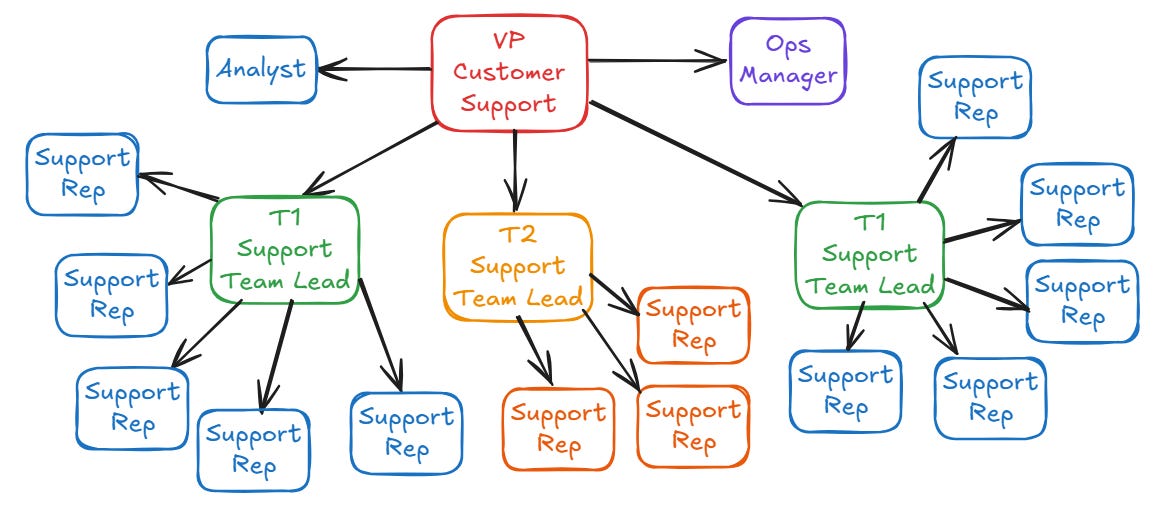
You have a VP who reports to the CEO or COO and he or she manages 3 support team leads (2 tier 1 and 1 tier 2), an ops manager responsible for tooling, documentation and training, and an analyst who helps pull numbers and prepares reports.
In the age of the implementor, the org chart looks very different:
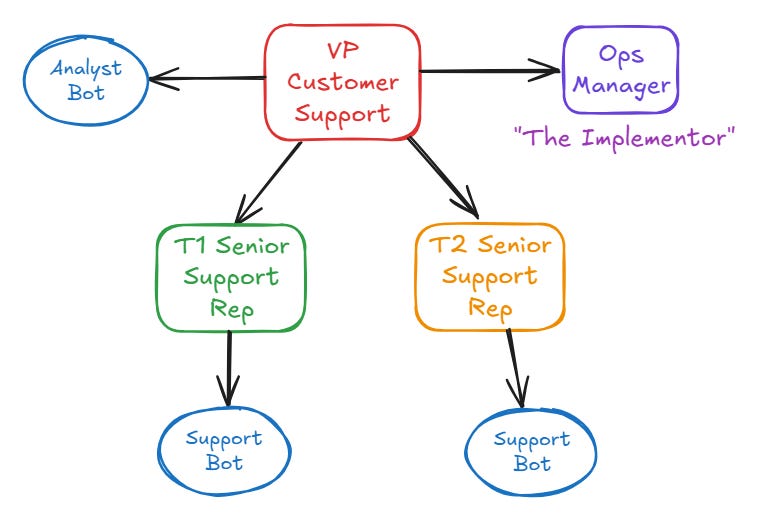
In the new org chart we’ve dropped 15 humans and replaced them with 3 AI bots, a 79% reduction in headcount.
The first person that is dropped is the analyst.
AI is good enough now that the VP can simply ask an agentic agent to pull numbers from the data warehouse and prepare reports. Once the KPIs, goals and report types are finalized, AI can handle the vast majority of the work.
For any ad-hock, complex data requests, the VP can escalate it to the data team who will have senior analysts on staff.
In the world of agentic AI, there simply isn’t enough day-to-day work to justify having department-based analysts.
The next role that drops off is the junior support rep. A tool like Intercom already has native AI support for drafting replies and responding to chats with a high resolution rate of 67%.
Even if you don’t use a tool like Intercom, setting up an agentic agent that can draft replies to emails is something you can set up in an afternoon.

Since the AI agents can work at scale and solve complex actions almost instantly, the difference in output between AI and humans is difficult to comprehend. Think of it like digging a ditch with a spoon compared to digging one with a mechanical digger.
The reason we still need human senior support reps in our support organization is for reviewing replies drafted by the AI, handling inquiries the AI can’t, or didn’t handle successfully, and for helping to improve the overal level of support provided.
These senior reps will need to handle a lot more ticket volume and we may need to hire a few more if we want to provide strict SLAs, but overall we’ll need far fewer and they can be paid better.
The ops manager has an even more important role to play in the organization since he or she is the “implementor”, the individual responsible for setting up, managing, scaling and optimizing the AI tooling and infrastructure.
This individual is a major force multiplier since without their help and skills, the organization couldn’t implement AI and maintain standards while cutting the workforce by 79%.
In my example the ops manager is the implementor but this doesn’t have to be the case. It could be a senior support rep who has the necessary skills to take on the job.
What can be said for sure is that everyone in the new organization needs to be at the bare minimum “AI aware”. This means that each employee understands what AI is, how it works, how to use it, and how it helps the business accomplish it’s goals.
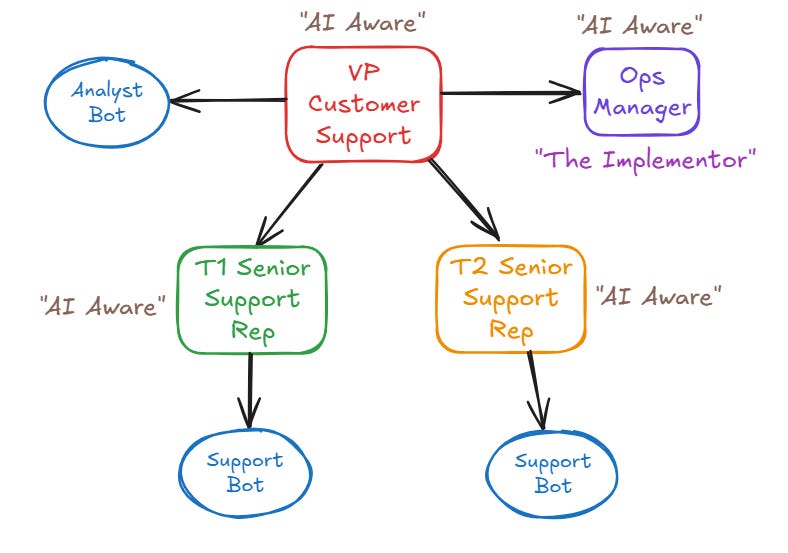
In the new world of AI driven task completion, you are either an implementor (“force multiplier and extremely high value to the business”), or you are “AI aware”, and still play a role. Everyone else is redundant, or soon will be.
Being “AI aware” will only protect you as long as you perform tasks AI can’t, or hasn’t learnt how to just yet.
So why are the majority of tech workers screwed?
There are four main reasons I believe most tech workers are going to be forced to make a significant change to how they earn a living in the next 24 months:
Most tech workers are performing tasks which AI either can already, or soon will be able to perform far better than them at a fraction of the cost. This will force these individuals to either pivot into different roles, switch industries, or become entrepreneurs.
Following on from the above point, most employees go to work to perform their tasks to collect a paycheck. From my experience most people don’t have a growth mindset and push back against having to learn new skills.
You can’t simply teach someone to become an “implementor”. The kinds of people that become “implementors” have personality traits, attitudes and a culture which you can’t refine in people. “Implementors” are curious, intelligent, like to learn new things, natural problem solvers and care about efficiency.
AI is simply too efficient. The number of humans organizations will need will continue to shrink. You only need so many “implementors”. Some businesses will outsource AI implementation and adoption to specialized agencies that can help many companies in parallel thus reducing the need to have your own “implementors”. Some companies will form an internal implementation team that is responsible for AI across the entire organization.
If you take into account these 4 factors, I think it’s clear that the vast majority of tech employees are f*cked.
So what’s the solution if there is one?
How to protect yourself in the world of agentic AI?
If you’re working in tech and concerned that AI is coming to take your job then you’re already a head of many who still have their heads in the sand. AI is coming for most jobs and we’re already seeing more and more startups reaching large valuations with smaller and smaller teams.
With all that being said, there are a few things you can do to improve your chances of riding out the disruption and keeping your paycheck.
Become an implementor
If you’re a curious person who likes to learn new things and enjoy problem solving then you’re probably a good fit to become an AI implementor.
If you’re working for a company which hasn’t yet started implementing AI then this is your chance to show management that you’re the right person to help.
To become an implementor of AI, you need to start learning AI, the tooling, how everything connects together, and to start experimenting and building a plan for how your department can use AI to scale.
My post below is a good place to learn some of the basics.
The complete bullsh*t-free beginners guide to AI for non-developers

👋 Hi there, I’m Justin. Welcome to another edition of SaaS Decoded. Each week, I publish an in-depth, actionable guide to help SaaS founders and operators grow their businesses.
By becoming the person in your organization that helps the company leverage AI to improve performance, you will have leverage and a lot harder to replace.
Once AI is good enough to implement itself throughout a business, even implementors will be out of a job. For now we need humans to implement, scale and manage AI systems.
Become an artist, entrepreneur, or change industries
If you’re not willing to learn new skills and “become one with AI” then you have 3 other choices.
You can either start your own business (not easy to do and requires learning a lot of new skills), change industries, or become an artist.
Changing industries is the easiest option in my opinion. There are industries which have not yet been heavily affected by AI and many tech workers will want to continue earning a paycheck with minimal disruption.
A junior analyst who just lost their job at Amazon could be hired by a shipping company which is still using legacy systems.
The problem is this is a losing battle since AI is spreading across all industries and it’s just a matter of time until certain jobs are wiped out completely.
It might take a few years but the analyst at the shipping company will end up in the same place as before, and have even fewer options available to him or her.
Many will choose to start their own thing and/or become artists (I include YouTuber’s, streamers, writers, etc in this category).
It’s never been easier to create things online and the number of individual creators making a living online is growing all the time.
I also predict “vibe-coding” will become more and more attractive, especially to junior and mid-level programmers who are replaced similarly to the junior support reps shown in my example above.
Ironically, these “vibe-coders” will use AI to create massive leverage themselves resulting in an explosion in single-founder / small team tech companies operating at very high margins.
In Summary
We’re all living through the AI revolution and it’s fundamentally changing how businesses operate. One of the main “victims” of this revolution is the average tech employee.
I’ve argued in this post that the vast majority of tech employees are f*cked and have less than 24 months to make significant changes to how they earn a living.
Employees that embrace AI, learn how it works and can help a business scale or efficiently have a chance of becoming “implementors”. These individuals are a force multiplier and become very valuable to their employer.
Those that don’t become implementors will need to change their role, industry, become entrepreneurs or earn a living as an artist.
Mass layoffs will continue and I’m pessimistic that most of those that lose their jobs will end up gaining new skills, finding a spot in a new industry, or succeed in making a living as an entrepreneur or artist.
I think universal basic income will become a requirement in some form or another, especially in the west.
How do you see things playing out? Let me know in the comments below.
If you enjoyed this post and want to get next post in your inbox, enter your best email below.
Thanks for reading and I’ll see you in the next one.
Justin