

Hey friends,
If you had to give a SaaS founder a genie that granted him 3 wishes, he’d use at least one of those wishes to reduce churn.
Combating churn is one of the toughest things to do in SaaS and it’s a very common cause for the downfall of many startups.
To make matters worse, churn is a complicated, non-standard KPI which many founders don’t truly understand.
If you choose to fight an enemy you don’t understand, you’ll end up losing.
In this post I’m going to share my list of fundamentals for combating churn. By the end of this post you’ll have learnt the following:
Why you’re measuring churn incorrectly and what to do instead
The different types of churn
Why reducing churn is often up to marketing, not product
By the end of this post you’ll know the enemy a lot better.
Definiting churn
The traditional way that churn is measured is the amount of recurring revenue lost divided by the total recurring revenue at the start of the period we are measuring.
Recurring revenue lost would be recurring expansion revenue minus lost recurring revenue.
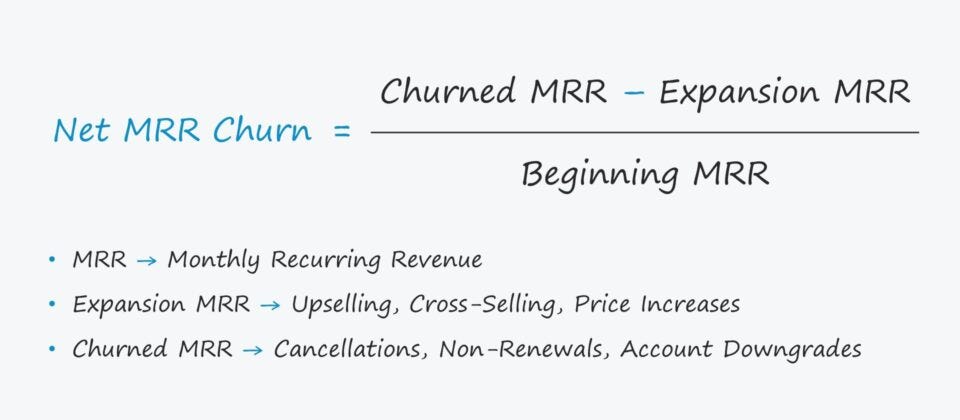
So for example, lets say at the beginning of January we had $10,000 MRR and by the end of the mouth we’ve lost $1,000 in recurring revenue, our net revenue churn rate would be 10%.
If you look closely at the formula above, you might notice that if your expansion MRR in the period is higher than your churned MRR, then your net MRR churn would be negative.
Negative net churn is the gold standard for SaaS. It means the business is growing its MRR from its existing user base.
We can look at churn in terms of revenue lost, or subscriptions lost. Revenue churn is a lot more relevant since not all customers pay the same amount in MRR.
Why you’re measuring churn incorrectly and what to do instead
Most SaaS businesses look at churn as a fully blended metric. This is fine when reporting numbers to the board, potential investors, or to the company in an all-hands meeting.
When it comes to combating churn, you need to “cut it open” like we’re performing an autopsy.
Let me share an extreme example to demonstrate the importance of segmenting churn.
Let’s go back to our example from early where we had 10% monthly churn.
Assume for a moment that after looking at the lost $1,000 in revenue that you noticed that basically all the cancelations belonged to customers that were on a monthly plan, and based in developing countries.
You dig deeper and notice than 84% of the cancelations are customers who never actually completed the onboarding.


These segmentation analyses tell a very clear story. The vast majority of churn in our hypothetical example belong to subscribers that are from developing countries that did not finish the onboarding.
Often the inverse is the real takeaway: “In January none of our cancelations were subscribers on an annual plan from a developed country; and only 4% belonged to subscribers from a developed country that did finish the onboarding.”
The hard part is to identify the variables which have the largest impact. Most startups simply aren’t collecting enough data to even conduct these types of analyses.
If you aren’t sure where to begin, start by writing down some hypotheses.
Some examples:
“Subscribers that have done X less than Y times are more likely to churn than those that have done X more than Y times.”
“Subscribers that have less than X employees are more likely to churn that those with more than X employees”.
“Once more than 3 team members have completed action X, the account never churns”.
Some variables worth using in your analysis:
Total number of key actions (emails sent, tasks created, prompts written, etc)
Number of active weeks (# of weeks where the user took a key action)
Size of the subscribers business (startup vs. >7-figures in revenue a year)
Number of team members actively using the tool
Geography is almost always a factor. A subscriber from New York is almost always more valuable and less likely to churn than one from central Africa. It’s just the reality.
The different types of churn
Not all churn is created equally which means not all churn can be combated the same way.
There are fundamentally 2 types of churn, Product Churn, and Structural Churn. Churn can either be active or passive.
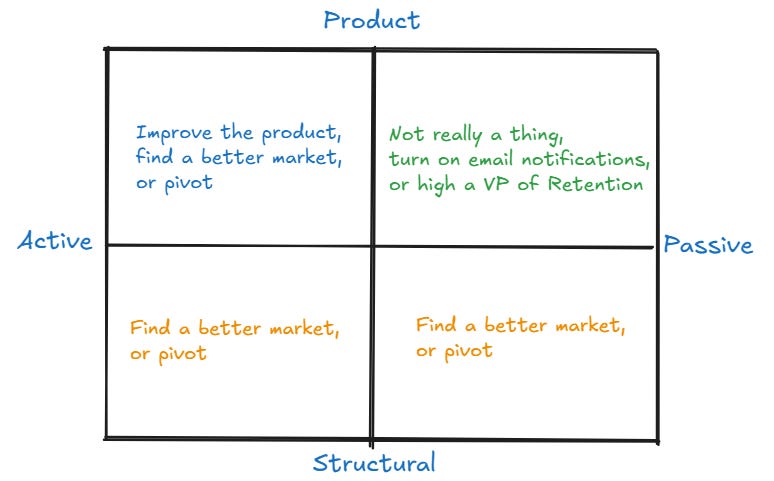
Product churn is the easiest to understand, it’s churn directly related to the performance of your product and/or company. If the product doesn’t do what its supposed to do, subscribers will cancel.
Same goes if the user experience is poor, support doesn’t do a good job, or the recent price increase is excessive.
Structural churn is churn that happens as a result of the nature of the market.
Gyms have very high structural churn because people struggle to build a habit around going to the gym regularly.
Another good example of structural churn is in the case of SaaS serving markets with high failure rates. A SaaS serving the restaurant industry will have high structural churn because the majority of restaurants fail within their first 3 years.
Structural churn is also the reason most B2C SaaS businesses have far higher churn rates than B2B SaaS businesses.
Product churn is most often active churn. Subscribers will manually cancel their subscriptions, or contact support to do it on their behalf.
Structural churn can be both active and passive.
If the subscriber goes out of business, like in the case of a restaurant in the above example, the credit card will fail to be charged and the subscription will end up being canceled.
Product churn is rarely passive, especially if you’re using a service like Stripe which sends out emails to encourate subscribers to update their credit card before it expires, or to add a new payment method when one does fail.
The solution to high passive product churn is to hire a head of retention who is responsible for following up with subscribers before their subscriptions are canceled as a result of failed payement collection.
If I had to pick one quadrant from the image above where real churn happens, I’d pick active product churn. This is the one area that you have a fighting chance.
Incremental improvements to the product, improved positioning and targeting a healthier market are the best ways to reduce this type of churn.
Why reducing churn is often up to marketing, not product
Notice how in 3 of the 4 quadrants in the image above, the solution includes “find a better market”.
The reason for this is because a lot of churn can be attributed to subscribers who weren’t a great fit for the solution.
Within each market there is a spectrum of “best fit” for any given solution.
Let’s say you build a solution serving lawyers. There are at least 5 ways off the top of my head I can segment that target market.
Type of law they practice (environmental vs. M&A vs. injury)
Solo practitioner vs. member of a firm
Geography (US vs. Europe vs. Rest of world)
Experience (just starting out vs. 10+ years practicing law)
Hourly rate ($50 vs. $500)
If my solution is serving all lawyers then I’m inevitably going to serve some better than others. I may find that my solution works best for experienced, American-based laywers with 5+ years of experience practicing M&A law.
The data might show that among that cohort, basically no one ever churns. Now imagine all my future subscribers match these exact characteristics? If the next 100 subscribers I gain all fit these criteria, what would that do to my churn rate?
Churn is a special metric because its truly owned by the entire company. Once the majority of the churn can be classified (product vs. structural, and passive vs. active), we know which department has the bigger responsibility to reduce churn.
In cases where the majority of churn is because of “bad fit”, it’s really on marketing to drive better subscribers to the business.
Consistent surveying of the user base, asking smart questions on support calls, and collecting the right info during signup and onboarding helps a ton to determine the “health” of your subscriber base.
In Summary
Before you can go to war against an enemy, you need to understand that enemy. Combatting churn often takes months of hard work across multiple projects.
Before you can start building a battle plan, you first need to dive deep into your cancelation, usage and demographic data to truly understand your churn.
Only then can you understand where the problems lie and how best to tackle them. You may find that the majority of your churn has nothing to do with your product and that the issue is the market you’re serving.
Start by drawing up a list of hypotheses related to your churn and then start analyzing your data to paint a picture. Use the frameworks I’ve shared in this post to understand the enemy, and then start fighting it.
That’s it for this week friends, thanks for reading and I’ll see you in the next one.
Justin
PS: I’ve made a lot of progress on the alpha version of Project Echo. If you’d like to give the service a try once it’s ready, visit projectecho.io and join the waitlist.
