

👋 Hi there, I’m Justin. Welcome to another edition of SaaS Decoded. Each week, I publish an in-depth, actionable guide to help SaaS founders and operators grow their businesses.
Hey friends,
In this week’s edition of SaaS Decoded I’m sharing the final part of my 2 part series on B2B SaaS growth tactics.
In part 1 I covered the following tactics:
Real-world meetups
Unique data-backed content
Programmatic “connector” SEO
Launch a startup program
Build an army of influencers by launching a marketplace
Product-Led SEO
Launch a “university”
Use extreme transparency to maximize word of mouth
Launch a “sidecar” product
Start as open-source, then build a hosted solution
In part 2 I will be covering the following tactics:
Creating a new role as a “Trojan Horse”
Strategic merch giveaway
Product demo on homepage
The “unhinged” TikTok persona
“Dogfooding in Public”
Build in public
Grow TAM using a stand-alone service
Strategic partnerships
Create a new category and own it
Launch apps on marketplaces
Let me know your favorite tactic from the series in a comment below the post.
Let’s jump in.
Growth Tactic #11 - Creating a new role as a “Trojan Horse”
One of the most well known companies operating in the “go-to-market” (GTM) space is Clay.
Back in 2023 Clay coined a new role, the “GTM engineer”.
According to Clay, a GTM engineer “can solve problems across any revenue-critical function”, and “build revenue engines using AI and automation”.
Clay’s history is interesting and covered in great detail in this post by West Operators.
According to the post, Clay struggled for years to optimize their messaging and only after shifting their focus to AI and the GTM market were they able to accelerate growth and become a category leader.

Another great resource on Clay’s history and their struggles nailing their ICP is this in depth post, Clay’s Path to Product-Market Fit — A 7-Year ‘Overnight Success’.
Why does this tactic work?
It’s very tough for a B2B SaaS to gain significant traction without having a very strong understanding of their ideal ICP.
By creating a new role and popularizing it, Clay was able to position themselves as a category leader. This tactic helps position a product as a “must have” which will accelerate growth and increase word of mouth.
Growth Tactic #12 - Strategic merch giveaway
In 2024 Yotpo launched their “walk away” campaign that created millions of organic impressions for their brand.

The campaign involved sending custom-made shoes to select influencers, Yotpo customers and others in their market.
The purpose of the campaign was to entice businesses to “walk away” from their existing email service provider (Klaviyo in most cases), and move over to Yotpo’s competing service.
Since only 100 pairs were made and distributed, those that received them were quick to share the campaign to social media.


The campaign was so effective that even people that didn’t receive a pair talked about it online.

According to Yotpo’s VP of Advocacy, Eli Weiss, the campaign achieved over 1 million organic impressions within the first 48 hours after launch.

Why does this tactic work?
The reason Yotpo’s “walk away” campaign worked is because it’s a “purple cow”.
The campaign was very different to the standard marketing campaigns run by B2B SaaS in the direct-to-consumer eCommerce space.
The campaign actually provided value to the recipients who were made to feel special since they were handpicked (only 100 pairs were made and distributed).
Yotpo picked the right people who had influence in their market. This meant that even if a fraction of the people that received a pair talked about it, a lot of potential businesses for their email product would hear about it.
Driving brand awareness is expensive.
The typical cost per mille (cost per thousand impressions) on a platform like Meta is in the range of $10 - $60+ depending on who is being targeted. Assuming a middle point of $30 per thousand. That would mean driving 1 million impressions would cost a business about $30,000. This would be the cost to just get the impressions on an advertisement, not to drive a million people to the website. That would cost far more.
By targeting the right people using a limited physical giveaway that made the recipients feel special, Yotpo was able to drive hundreds of thousands of dollars in media to their brand at a fraction of that cost.
Growth Tactic #13 - Product demo on homepage
The quicker you can demonstrate the value your product provides, the quicker people will “get it” and know if its what they need.
Senja is a testimonial collection and publication SaaS that does a great job of showing off what they do on their homepage.

After scrolling down on their homepage you will start seeing a ton of testimonials displayed in a grid. Scroll down some more and you will see the Senja badge, proudly showing that Senja use their own product on their homepage.
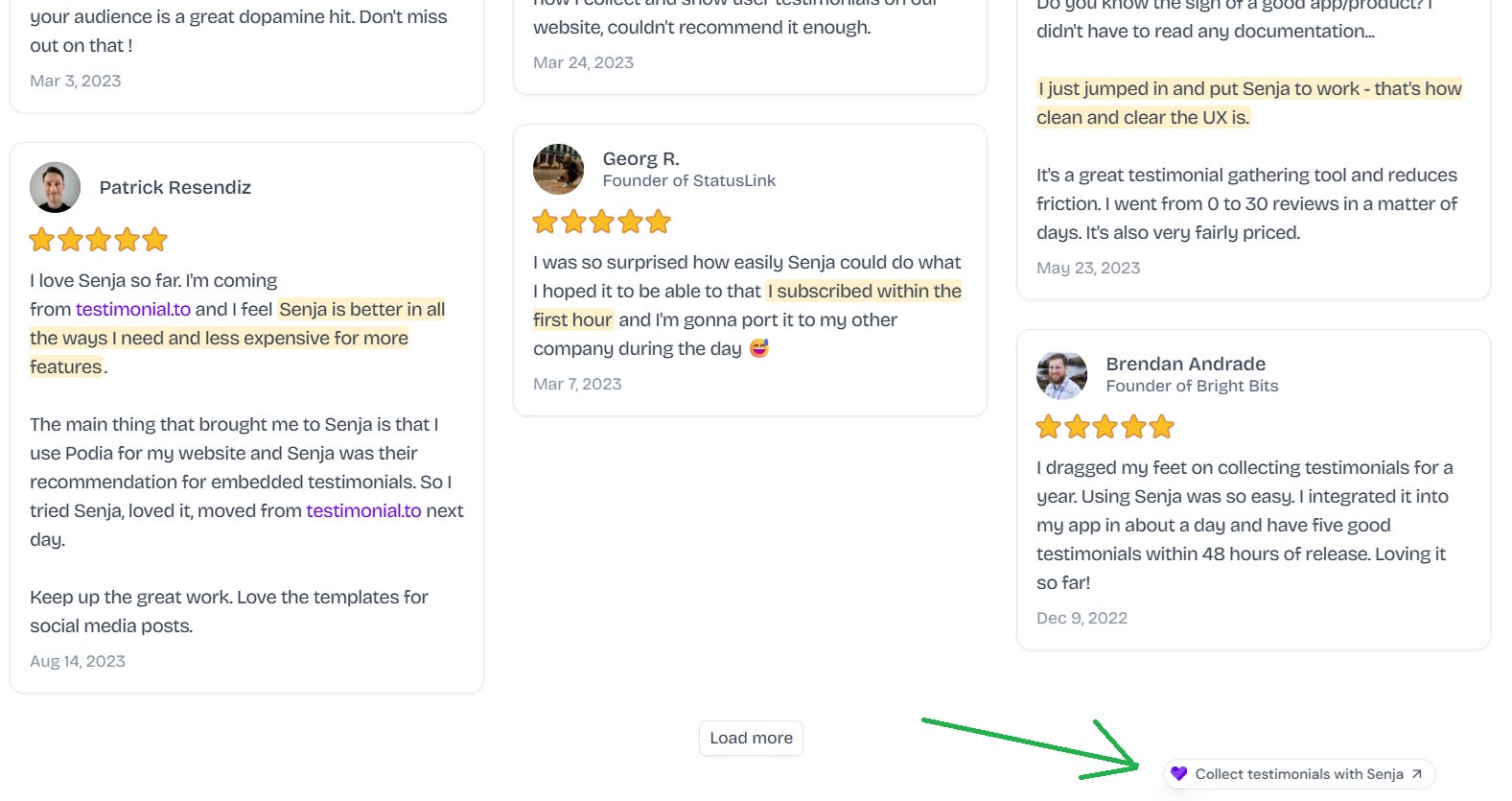
The use of a homepage-based demo of the product with a ton of social proof will do wonders for Senja’s visitor-to-signup conversion rate. This is a powerful combination that all SaaS should try and leverage if possible.
Why does this tactic work?
The average person’s attention span is getting shorter every year. Businesses need to make it clear what they do and how they help within a few seconds or risk losing potential users.
If a SaaS business can demonstrate their product directly on their homepage, either by showing off the actual product, like in the case of Senja, or through a short video, they will have an advantage over businesses that don’t.
The homepage is a SaaS business’s most important online real-estate, and should be optimized to help visitors make a decision within a few seconds of landing on the page.
Growth Tactic #14 - The “unhinged” TikTok persona
Duolingo is a SaaS business that has absolutely crushed it on TikTok.
Today the company has over 17 million followers and 473 million likes on their videos.

After watching a few of Duolingo’s TikTok videos you start to see a pattern.
The videos are "unhinged” and designed perfectly for the younger TikTok audience. Duolingo understands that to stand out on TikTok, videos need to raise eyebrows.
The consistent use of branding (green color, maskot, etc), music, sharp visuals and a fun, humorous style makes Duolingo’s videos stand out on a very busy social network like TikTok.
Why does this tactic work?
If the name of the game is to get attention then there are few places today where more attention is spent than TikTok.
By mastering TikTok, Duolingo was able to leverage the platform’s viral nature to reach millions of potential users for their platform.
TikTok is a platform that is better suited for B2C SaaS but shouldn’t be dismissed entirely by B2B SaaS.
The right content on TikTok can go viral and reach a very large number of people resulting in a high ROI.
Shopify, Canva, CapCut and Adobe are just some B2B SaaS businesses with large audiences on TikTok.
Growth Tactic #15 - “Dogfooding in Public”
“Dogfooding”, and “eating your own dog food” are terms used to describe a business that uses it’s own product. “Dogfooding in public” is when a business uses their own product publicly.
A great example of a business that uses this tactic is Plausible.
Plausible is a Google Analytics alternative that uses their own product to track their web analytics.
When visiting Plausible’s homepage, you’ll notice a “View live demo” call-to-action.

After clicking this button you’ll be taken to a live demo of the Plausible product showing Plausible’s actual web analytics data.

This not only allows you to see the product in action, but creates trust because you can clearly see that Plausible is using their own product. It creates the question in the visitor’s mind, “if it’s good enough for them, perhaps it’s good enough for me?”.
Why does this tactic work?
The use of a live demo is a great way to quickly show the value a product provides.
Add to that transparency and “dogfooding” and you have a powerful combination that immediately creates trust between the viewer of the demo and the company behind it.
This trust will result in a higher conversion free-to-signup conversion rate, more product demos and higher conviction behind the product.
Growth Tactic #16 - Build in public
The tactic of building in public isn’t new. Last week, in part 1, I mentioned Buffer which I consider the most public company in the world.
Buffer is an extreme case of using transparency to create word of mouth and interest in your business, but there are many SaaS businesses which choose to use transparency to stand out by “building in public”.
Peter Levels is a well-known “indie developer” who embraces the “build in public” philosophy.


The idea behind building in public is to share frequent updates and the “story” behind building the product, or software business.
This not only helps market the product, but is also a way to create an audience, gather feedback, and create some buzz around your personal brand.
X is a great platform for those that want to “build in public” but isn’t the only platform that can be leveraged. I personally lean into this philosophy through Coffee + Revelation, my personal substack, where I publish updates on my entrepreneurial journey.

Some other examples of SaaS founders that “build in public”:
Tony Dinh (@tdinh_me)
Simon Høiberg (@SimonHoiberg)
Guillaume Moubeche (@GuillaumeMbh)
Danny Postma (@dannypostma)
Why does this tactic work?
Transparency is a virtue that people are attracted to, therefore those that use transparency as part of their communication style standout in a very noisy world.
By regularly sharing updates on their entrepreneurial journey, changes they’ve made to their products, and other personal insights, the individuals I’ve listed above have created huge, loyal online followings.
Having an audience of tens of thousands of loyal fans is a very valuable asset that these entrepreneurs can leverage at anytime to test new ideas, gather useful feedback, and help market new products they launch.
Growth Tactic #17 - Grow TAM using a stand-alone service
Stripe is a popular fintech company used by developers for subscription management and payment collection. Unfortunately because of regulatory reasons Stripe doesn’t operate in every country.
I’ve personally dealt with this problem being a tax resident in Israel. Other countries where Stripe isn’t available include India, Argentina, Indonesia, Russia, and South Korea. Stripe is available to businesses in 46 countries.
If someone in one of these restricted countries wants to use Stripe, they will need a business entity in a country which is supported, such as the USA.
Back in 2016 Stripe launched a stand-alone service called Stripe Atlas.

Stripe Atlas helps non-US individuals form a US-based limited liability company (LLC), or corporation (c-corp).
For just $500, the Stripe Atlas team will submit the necessary paperwork to the US government and help you create the entity.
Since launching, Stripe Atlas has helped over 100,000 founders incorporate their businesses in the USA.
I’ve personally used the service twice and I’m a big fan.
As a direct result of Stripe Atlas, I now have 4 micro SaaS running on Stripe, each paying fees to Stripe every month.
By offering a stand-alone service, Stripe has managed to grow it’s total addressable market (TAM) while making over $50 million in setup fees along the way.
Why does this tactic work?
By offering a stand-alone service that solves a real pain for a potential customer, you not only build trust, but enable someone to start using your core service.
Stripe has managed to do this at scale (100k+ businesses) but as long as the economics work, any B2B SaaS could create a stand-alone service that removes a potential roadblock for individuals that want to use their core service.
This tactic would work best in industries which have a lot of regulation, geographical constraints, and legal considerations.
Growth Tactic #18 - Strategic partnerships
Mercury is a fintech company that I’ve growth to love over the last 3 years.
Mercury provides a fantastic service to entrepreneurs that need US-based online banking services.
On top of providing an incredible online banking experience, Mercury uses strategic partnerships to provide financing options to users.
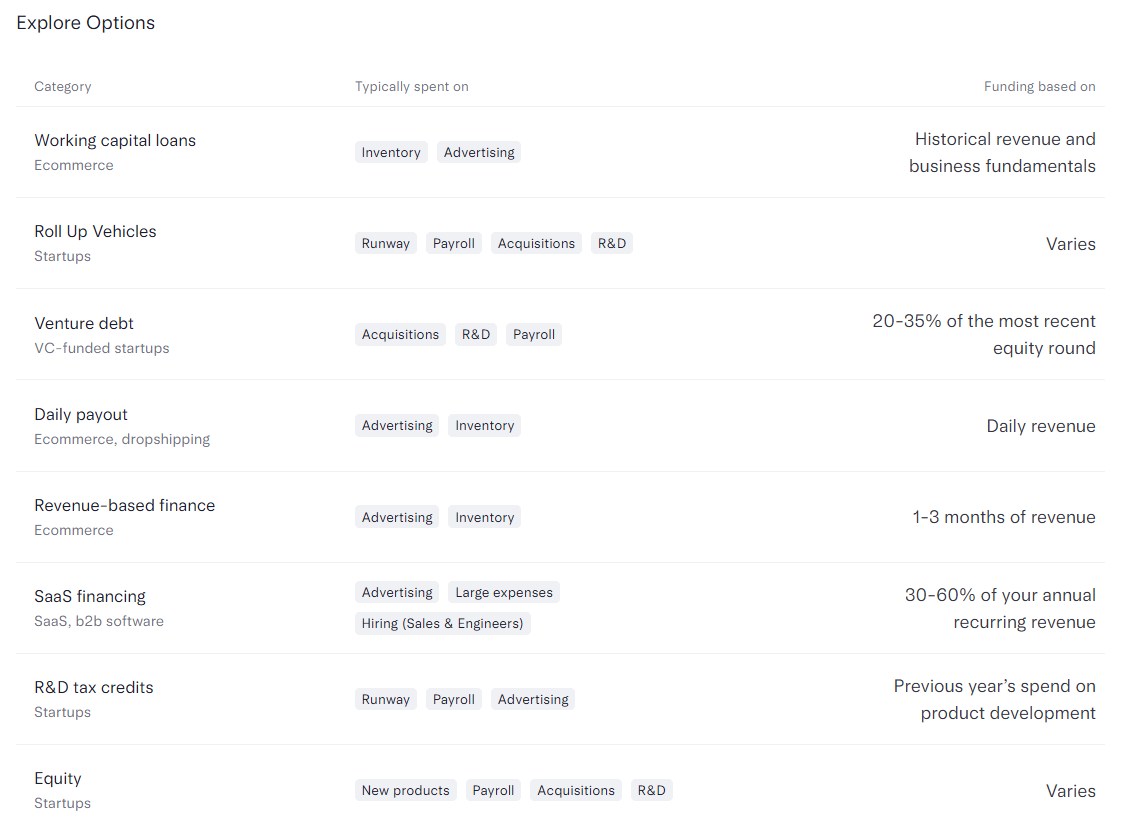
By partnering with other fintech companies that offer different financing options, Mercury is able to provide value throughout most of the lifecycle of their users. Startups get online banking services, and more mature businesses that need to raise capital can leverage Mercury’s partnerships.
This allows Mercury to focus on their strengths while using others to provide additional value.
Stripe Atlas has also used strategic partnerships in a very affective way.

Stripe Atlas helps entrepreneurs set up US-based business entities like LLCs and C-corps but setting up the entity is only one step towards running a successful business.
Stripe Atlas has partnered with a long list of service providers from bookkeeping to virtual mailbox providers. This allows Stripe Atlas to provide huge additional value to their customers while also getting new business from their partner network.
Why does this tactic work?
Building partnerships with companies that provide value to your users in an adjacent area is a great way to amaze your users without needing to shift too much focus away from your core business.
Building a network of partners can be a great, high leverage way to drive new referral business.
Growth Tactic #19 - Create a new category and own it
Back in 2005, Brian Halligan, the CEO and co-founder of Hubspot famously coined the term, “inbound marketing”.
Brian had seen how consumers were getting better at blocking out ads and outbound marketing and used the term to describe this shift.
For most of the last 21 years since then HubSpot has positioned itself as the “all-in-one” software solution for inbound marketers.
HubSpot’s emphasis on using content, lead magnets, and SEO to drive top-of-funnel awareness of their brand is directly out of their inbound marketing playbook.
Their focus on educating the market through the HubSpot Academy has helped to turn tens of thousands of marketers into “inbound marketing” evangelists.

Why does this tactic work?
HubSpot introduced a brand new way of marketing to the world just as social media was gaining traction.
This contrarian approach helped create massive brand awareness for HubSpot among the digital marketers of the world who connected strongly with this new way of thinking.
The concept of inbound marketing spread online like a wildfire which helped HubSpot’s revenue grow to over $50M within less than 7 years.
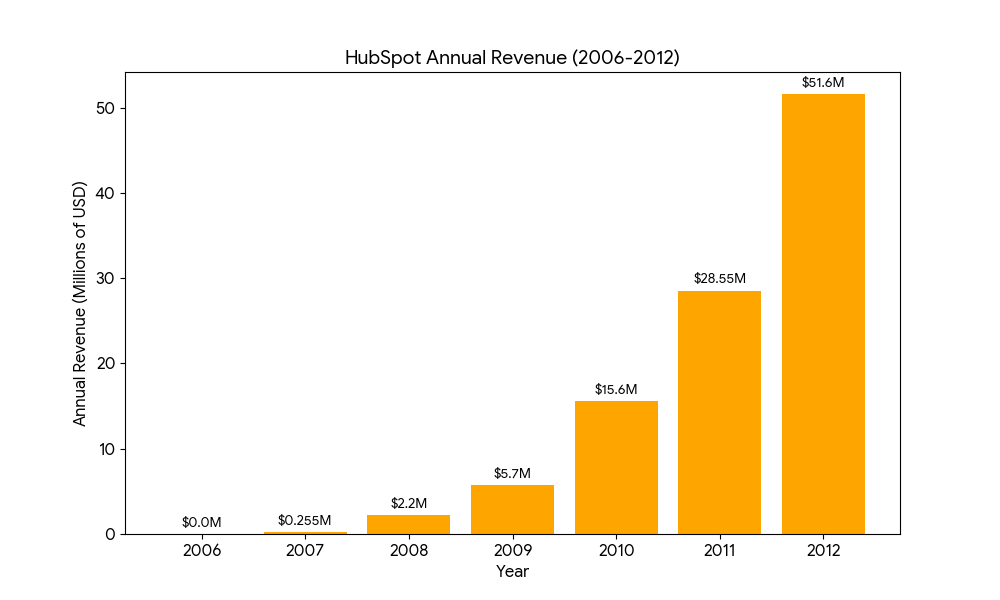
By owning the category and helping to shape it into a real set of beliefs that millions of marketers around the world could connect with, HubSpot become both a “thought leader” and “must-have” solution for a new generation of digital marketer.
Growth Tactic #20 - Launch apps on marketplaces
Asana is one of my favorite productivity apps.
As a stand-alone app, Asana is fantastic, but the company has proactively launched integrations on a number of platforms which makes using it seemless across so many platforms.
A great example is Asana’s Slack app.
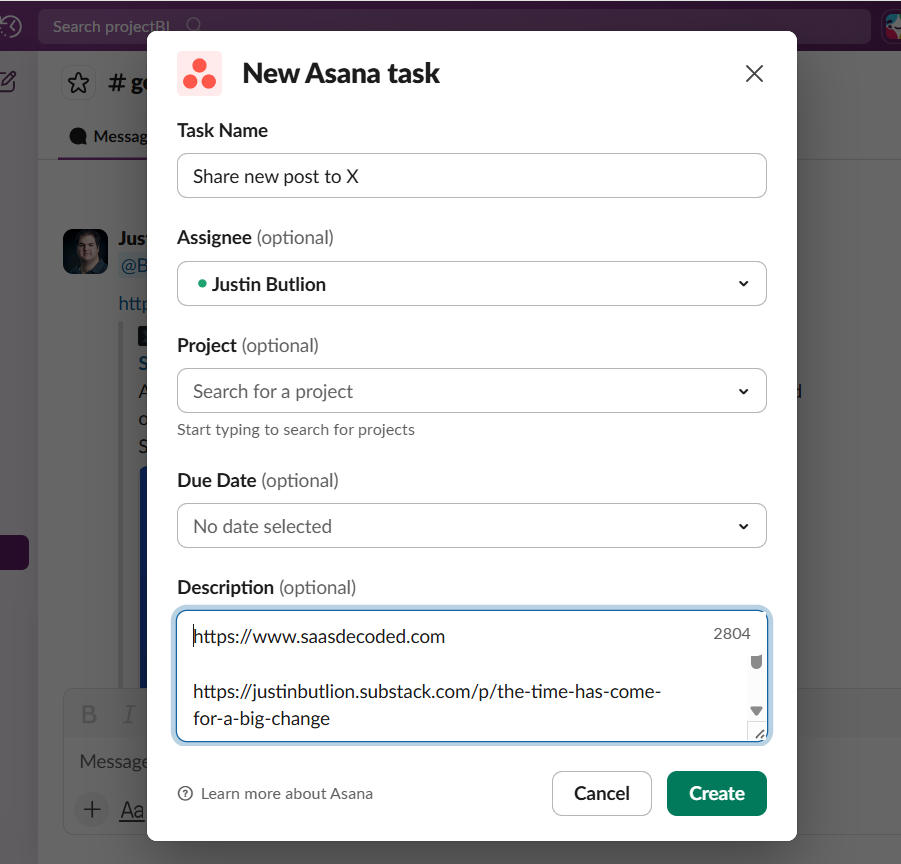
I often use their Slack app to create tasks directly from conversations in Slack.
Asana has integrations with Microsoft Teams, Zapier, n8n, Harvest and dozens of other workflow-related applications.
In some cases these businesses have built these integrations because of Asana’s popularity, but in many cases the apps were built and managed by Asana directly.

Why does this tactic work?
By being listed in so many popular app marketplaces, businesses that adopt this tactic can benefit from a lot of “free” exposure.
As long as your app is of high value to the marketplace it should get good reviews which will lead to higher rankings and more direct exposure.
Existing users benefit from this tactic since they are able to connect more and more of their apps together, leading to higher usage and better retention.
Which of the 20 tactics I covered in this series did you like the most? Let me know in a comment below.
If you enjoyed this series and want to get next week’s post in your inbox (I publish a new post every Tuesday at 10AM EST), enter your best email below.
Thanks for reading and have a great week.
Justin