

Hey friends,
Today I’m launching a new series, $0 to $10k MRR. In this series I will be sharing my journey building a SaaS from scratch to $10,000 in monthly recurring revenue.
In this post I’m going to be sharing the following:
Why I decided to build this specific SaaS
How exactly I’m building it
What the SaaS can do in its current form
Next steps and how you can help
My goal with this series is to be as transparent as I can and provide a real-world account of what it takes to go from idea to 6-figures in MRR.
Strap in, this is going to be a lot of fun:)
Introducing the SaaS - Project Logbook

Project Logbook tracks the activities you do across your tools so you can analyze, share and build habits around the work you do.

You have complete control over which activities are logged, what is shared to your public profile, and how everything is displayed.
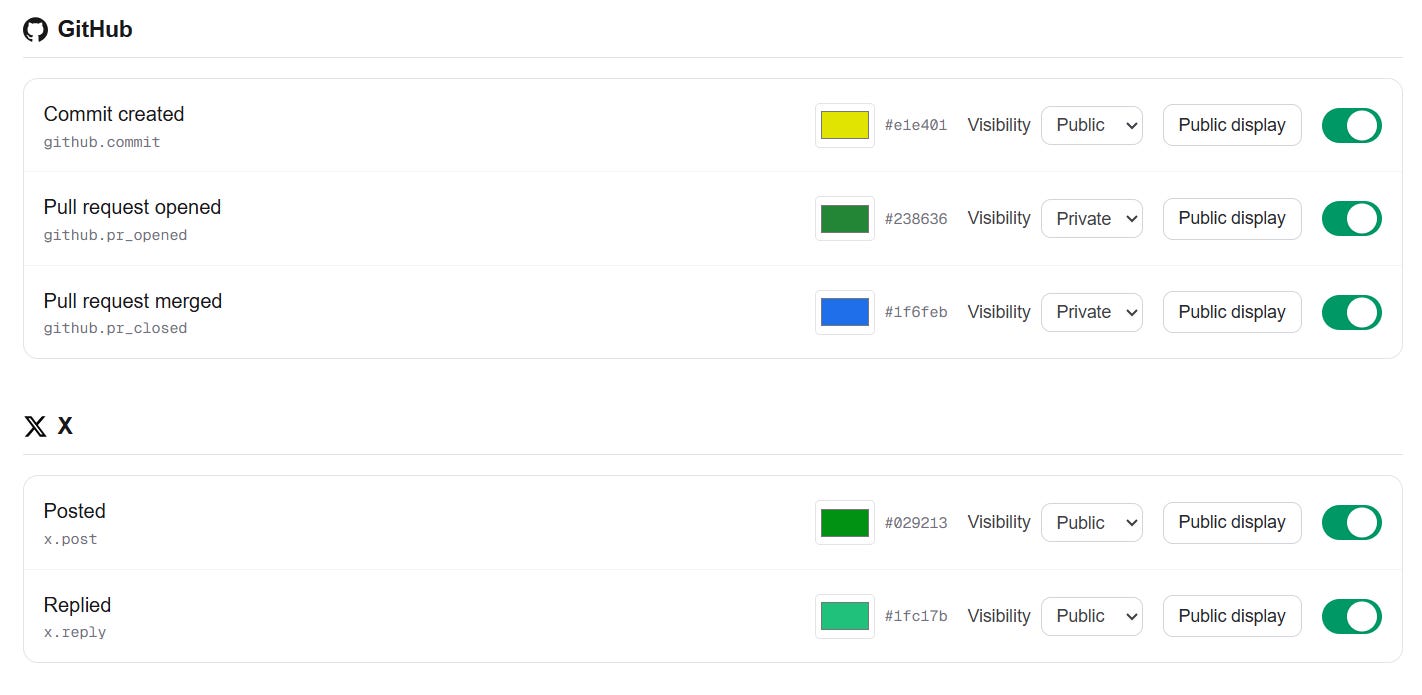

The MVP was launched with the following integrations:
Asana
X (formally Twitter)
Github
Substack
Wordpress
I purposefully skipped a lot to get the MVP lean. The list is long but here are some of the things still missing.
No logo
Shitty design
No focus at all on SEO (there’s no sitemap, optimized title and meta tags etc)
It’s not optimized for sharing on social media
I’ve integrated Userjot but I’ve spent zero time in the admin console
No onboarding email flow
No event tracking (I can’t easily see usage without querying the database)
Can only sign up via email
Not optimized for mobile
Only some activities per integration are supported
Why this SaaS?
The idea behind Project Logbook came to me from a collection of different sources.
Firstly, as a solopreneur, doing work across multiple platforms (X, LinkedIn, Slack, Asana, Gmail, and the list goes on), at the end of the work week it’s difficult to know what exactly was accomplished.
I’ve tried to solve this issue by creating tasks in Asana for every piece of work but the work itself is too fluid and dynamic to have it all in Asana at all time. I don’t want to create extra work to know what work I got done during the week.
Rigging up an agentic agent that sends a daily summary is an option but its a lot of work and limiting.
I believe that in 2026 there is a place for a dedicated platform that can act as a repo for all the work we do. Once all the “work data” is in one place, interesting things can happen.
The next source of inspiration was wip.co, an online community of “makers”.
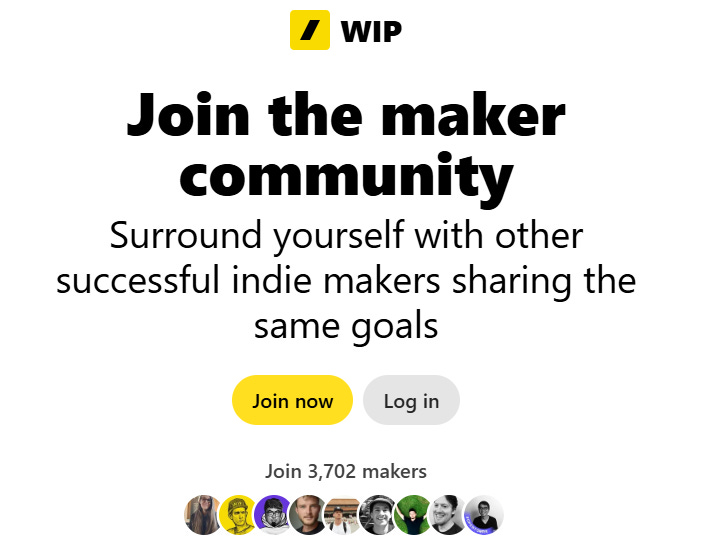
I like the idea behind wip a lot but I’m not a fan of the execution.
It’s a paid only community (unless if you’re invited?), has little to no automation (from what I can tell), and comes across as outdated.
I don’t mean to hate on wip, it’s no small feat building a thriving community of 3.7k individuals, I just think there is an opportunity to build something better.
There are a number of other reasons I’m a fan of the Project Logbook idea:
It’s targeted at a large B2B market - solopreneurs, indie developers, and other creatives (the main target market for Project Logbook) are on the lower end of the B2B spectrum, but it’s still B2B. There are millions of potential users and its a growing market.
Simple tech stack and path to MVP - I’ll go into more detail on the exact tech stack I’m using for Project Logbook later in the post but I knew going in that it could be built using a relatively simple tech. I more or less knew before I started what I wanted to include in the alpha version.
I can leverage product-led growth - Project Logbook will be bootstrapped so there won’t really be a marketing budget. The plan is for growth to come through use of the product and word of mouth. Project Logbook will have an extremely generous free plan. I’m using a similar approach to that of Tally (an extreme free plan).
I can accept a low conversion to paid - Since I don’t need to pay the bills from this SaaS and I plan to stay bootstrapped, I can accept a low conversion from free to paid. I will go into a lot more detail in a future post on my monetization plans and pricing strategy. For now just know that I’m going in expecting a conversion from free to paid of less than 2%.
If it doesn’t work, I don’t lose much - Since the setup costs are so low and I’m not building an overly complicated platform, I lose little for giving this a shot. This is what you’d consider an asymetric bet; I lose little if it doesn’t work (mostly time), but if it works I could end up with a very valuable asset.
I don’t need a team - I plan to build Project Logbook without a team. I may hire contracts at certain points but there will be no full-time team members involved on the journey to $10k MRR.
Scratching my own itch + interesting niche - I’ve wanted a solution like Project Logbook for a while. I think its important to “scratch your own itch” and “dogfood” your own product. Project Logbook checks both of those boxes. I’m interested in the whole productivity / data tracking niche which will help me stay engaged and push through the “valley of death” as I work towards product market fit.
It’s an infinite game - Once Project Logbook has been validated by the market and has some traction, it’s a project I can sync my teeth into for years to come. There is something very excited about building my own software platform and turning ideas into tangible tools which provide value to people around the world.
How are you building the SaaS and what’s the tech stack?
I’m building Project Logbook using Cursor on my laptop. I’m prompting the Cursor agent who does the rest.
Here is the tech stack:
Coding agent - Cursor ($20 a month)
Version control and code repository - Github
Cloud host - Render
Web server - Render ($7 a month)
Database - Postrgres (hosted on Render, $10 a month)
Cron - Github Actions
Domain registrar - Namecheap (the domain cost me $34.98 for the year)
Email service provider - Postmark (free under 1k emails)
Web analytics - Plausible (I already have an annual plan so I can add multiple sites, no incremental cost)
User feedback / feature request management - Userjot (free)
In total the monthly costs to build and run Project Logbook is about $40, not including my time.
The app is built using Node (backend) and Typescript for the front-end. I’m basically building in production which I know is a no-no but it’s working for me for now.
So far 100% of the code has been built using Cursor via prompts.
So what are the next steps?
Project Logbook, in its current form is an “alpha” build. I’m looking for a handful of users to sign up and start using the service so I can start collecting feedback.
I plan to add Gmail as my next integration since that’s where a lot of work is being done.
I will also be adding Google oauth for signing up and logging in. Right now users can only signup via email.
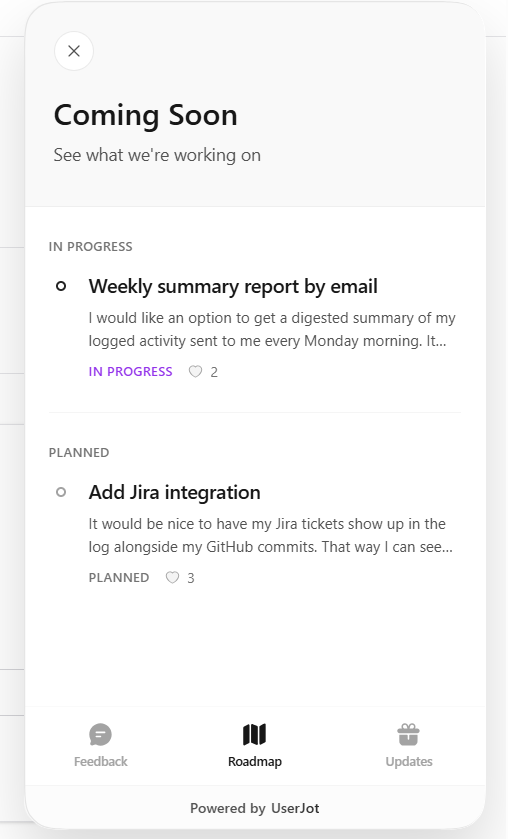
The next big feature on my list is email “summaries”.
Some other dev work I have in mind:
Goals - Set up activity specific goals and track them in the app (“publish one post every week for the next 10 weeks”, or “Commit code to repo X at least 3 days next week). Goals will also be sharable on the public page.
MCP server - Allow you to connect Claude, Viktor and other AI tools to Project Logbook so you can run your own analyses and trigger workflows outside of Project Logbook.
A lot more integrations - HubSpot, LinkedIn, Slack, Monday.com, and many more.
Monetization - It’s still quite early but at some point I need to integrate Slack and decide on which features will be gated vs. which will remain free.
In the long term I want to rely on user requests and feedback to shape the product roadmap. I want to involve the user base as much as I can to shape the future of the platform.
This is why I’ve integrated Userjot so early.
What if it doesn’t work out?
The deadline for validating Project Logbook is 15th August 2026, approximitely 3 months from now. If by that date there isn’t at least some signs of traction, I’ll shelve the SaaS and move onto the next idea. 3 months is enough time to validate the idea.
Since we now live in a world where a non-developer like myself can use AI to build software, the game has completely changed. It’s now a matter of picking the right idea, serving the right market and playing the numbers game.
If I dedicate myself to building one SaaS every 3 months (4 a year) until I’ve got clear signs of traction (and then double down), it’s just a matter of time until I’ve built a new SaaS to 10k MRR.
Here’s the best part, I can share the journey with you all, learn a ton of new things, and play an infinite asymetric game that has huge financial potential, with little to no risk. I’d be a fool not to at least give it a try.
How can I help?
I know its very early days and Project Logbook is just getting started but the best way you can help me out is by signing up to the service and giving it a try.
If after a day or two you feel it’s not for you, that’s completely fine.
The second best thing you can do is click on the share button below and share this post on your favorite social network.
The more people that follow this journey, the better. I want to spend as much time as I can shaping the product so every extra set of eyes you can help send to Project Logbook, the better.
Enjoy your weekend and I’ll see you in the next one.
Justin