

Last night I lay in bed scrolling on X when I came across the news that Tally had just reached $5M in annual recurring revenue (ARR).

This was the absolute best timing since I was deep into researching the company and their last major announcement was back in October 2025.
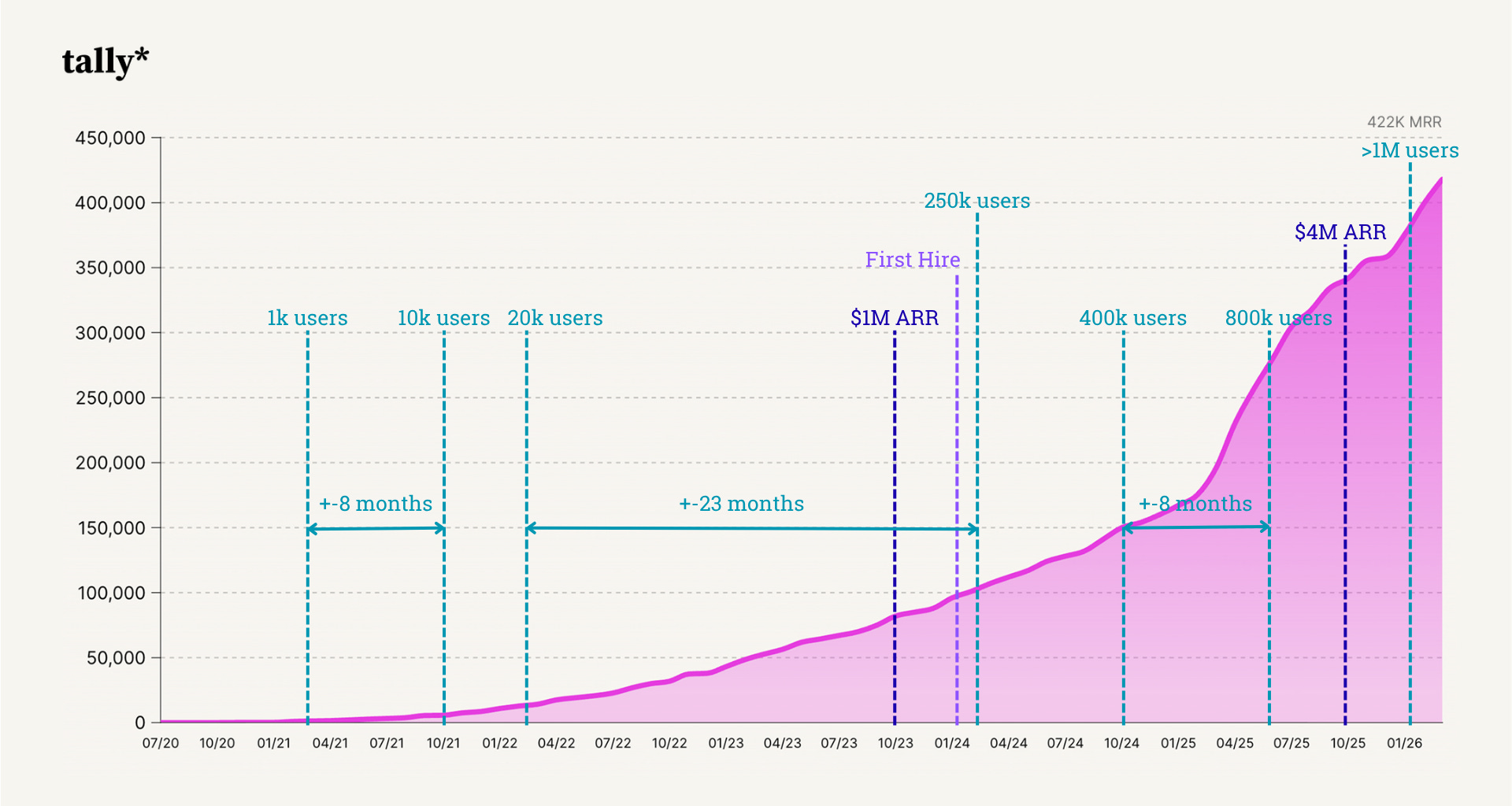
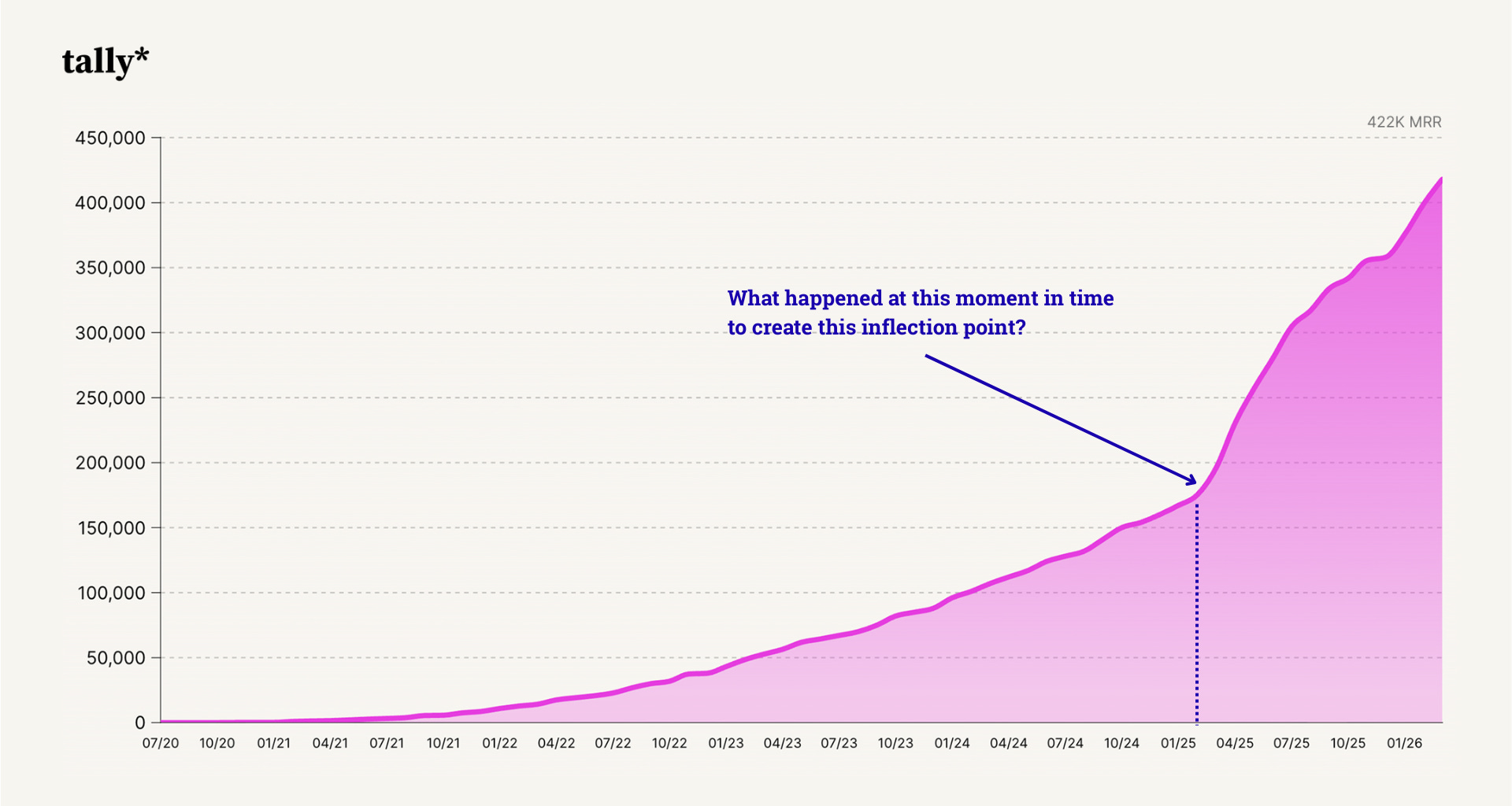
I knew Tally must have been close to $5M ARR because of the exponential rise in their MRR (just look at that graph!), but I couldn’t be sure. I thought I may have to take a guess. Thankfully Marie Martens, Tally’s founder saved me the trouble.
There are many important lessons that can be learnt from Tally’s bootstrapped journey to $5M ARR. My goal with this post is to share as many of those lessons as I can.
Thankfully Tally “builds in public”, and has from day one, so there is a huge amount of information that has been shared by the company’s founders over the years.
I spent over 15 hours going through hundreds of posts on X, multiple podcasts, blog posts, and other content as part of my research into Tally.
The result is this post; a 5,000 word deep dive into how Tally bootstrapped their way to $5M ARR in just 5 years.
The company reached this milestone with a team you could sit around a large dinner table, a lot of very smart business decisions, and incredible patience.
By the time you’re done reading this post you’ll have a complete playbook for building a bootstrapped B2B SaaS business in a large, highly competitive market.
In this post I’ve covered the following topics in detail:
How Tally got started and gained their first 1,000 users
Tally’s mission, company culture, and team breakdown
The genius behind their pricing model, positioning, and product development philosophy
How Tally grew to over 1M users and 12,000 customers
An analysis of their MRR growth
A summary of the key lessons from their journey to $5M ARR
This is a long one so you might want to get a new cup of coffee before diving in.
Enjoy!
How Tally got started
Tally was founded by Marie Martens and Filip Minev, two Belgium entrepreneurs, in mid-2020.
Earlier that year they were working on their first startup, HotSpot, a marketplace for travel influencers to connect with hotels. Because of covid, they lost momentum and decided to pivot. It was during lockdown that the couple came up with the idea behind Tally.
Both Marie and Filip had used different form builders throughout their careers but hated the poor design and user experience of Google Forms, and found Typeform, a popular option at the time, as overly expensive.
These clear pain points, and some influence by Notion, helped seed the idea for Tally.
“Tally is the simpliest way to create beautiful forms or surveys without needing to know how to code.” - Marie Martens, Co-founder of Tally
How Tally signed up their first 1,000 users
By September 2020, Marie and Filip had finished building a minimal viable product (MVP) and started sharing it online to gather feedback.
Cold outreach and social selling were the two main channels the founders used to sign up their initial users.
They focused on no-coders, indie-makers and product hunt users who had engaged with similar products to Tally.
Marie covers this topic in more detail in the video below.
The initial users were also invited to a Slack community where they could interact with the founders and continue to share feedback.
The combination of Tally being free, having a powerful usage-based flywheel (more on this later in the post), and the smart decision to prioritize outreach to individuals with their own audiences, meant that Marie and Filip were able to sign up over 1,000 users in just a few short months.
Launching publicly on product hunt 5 months after the MVP went live helped doubled their user base, and provided clear validation that the two founders were onto something.
Tally’s mission, company culture and team structure
The more I dug into Tally’s story the more I came to realize that a huge part of their success lies in their company culture.
Culture is everything and Marie and Filip have done an amazing job in creating a culture that aligns exactly with how they want to build Tally.
Understanding what is needed to succeed and focusing relentlessly on the things that matter
It’s clear that early on in Tally’s story, Marie and Filip understood that there were a few key areas of focus.
At the end of the day it came down to the product.
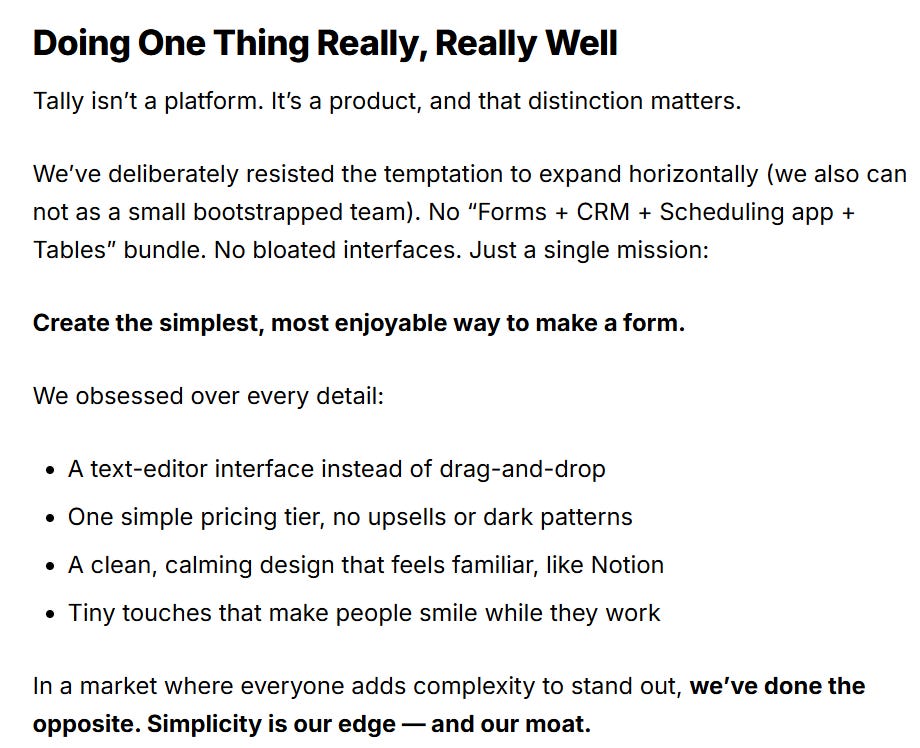
“Tally isn’t a platform. It’s a product, and that distinction matters.” - Marie Martens, co-founder of Tally
Since Tally was bootstrapped the company couldn’t afford to compete against the rest of the market through traditional means.
Tally would need to be a world-class product that amazed users so that they would rave about it. This would allow the company to scale through product-led growth organically.
Almost every decision, from starting a Slack community for free users, to their genius pricing model, ties back to this overarching strategy.
Make a world-class product —> Users will be amazed and tell the world about it —> more users sign up —> Some upgrade to a paid plan.
Since the growth strategy was now clear, Marie and Filip would systematically structure the whole company around this central “pillar”.
This meant having to accept:
Slower growth.
No full-time employees for the first few years.
A product-first culture.
Doing a lot of things that don’t scale.
Being patient so the flywheel can pick up speed.
Building the business on their terms meant saying “no” a lot.
That since there won’t be a lot of revenue for a big team, the product needs to stay simple and be easy to use to keep support costs low.
It would take years to reach meaningful scale.
All these key decisions were aligned with the main “pillar”, the growth engine, thus keeping the business focused and working constantly towards building more leverage.
The last piece of the puzzle was time and the founders were in no rush.
Tally’s team structure
At the time of writing this post, the Tally team was made up of 11 individuals, including the two co-founders.
Historically Tally either had no full-time employees or a mix of some full-time and some freelance. I wasn’t able to determine which of the 11 today are full-time and which are freelancers.
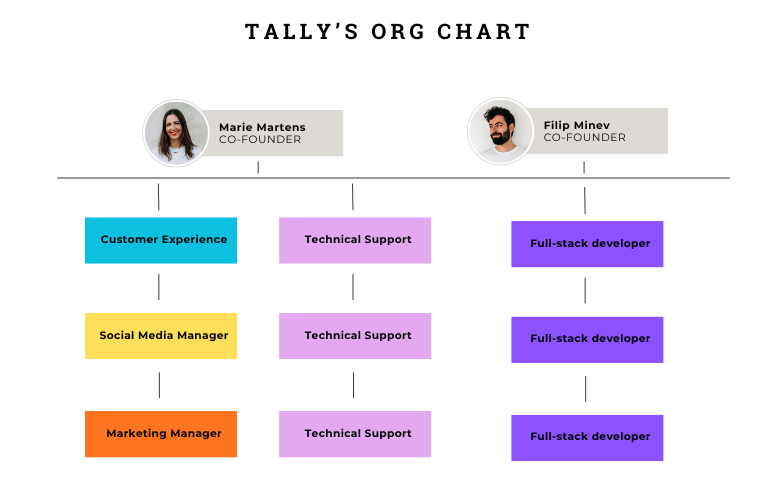
The Tally organization is very lean, especially for a business making millions a year and with over 1M users.
At $5M ARR, the company has an incredible ARR-to-team member of $454k.
The fact that there are only 3 support reps serving so many users says a lot about the company’s obsessive focus on building an easy-to-use product.
According to Marie, roughly 35 support tickets get generated daily. That’s an incredible number for such a large user base.

For most of the company’s history, Marie was the sole marketer in the company.
The recent additions of a marketing manager and social media manager tells me that Tally understands that in order to accelerate growth, marketing will need to be delegated to a team.
From a product development standpoint, we see that there are 3 full-stack developers. The most recent addition to the dev team was in January 2026.
My guess is that Filip is responsible for R&D while Marie handles support and marketing.
Marie and Filip have always wanted to keep the team small. This lines up with their company culture and patient approach towards scaling.
At the time of writing this post there are no open positions listed on Tally’s careers page.
The genius behind Tally’s positioning, pricing model and development philosophy
One of the areas of business I find the most interesting is how a company chooses to align key variables that matter in its market.
For example, a restaurant can choose to serve a large menu to the “everyman”, or specialize in a few dishes aimed at a richer clientele.
When analyzing Tally, I found that the company had aligned its key variables perfectly for the needs of the founders, and for the market they operate in.
The first thing to point out is that by operating in a very large market, the Tally founders could position themselves almost anywhere, and with enough grit and hard work, run Tally as a nice “lifestyle” business.
By choosing to focus on building a great user experience while offering the most generous free plan on the market, Tally happened to position themselves in a segment of the market which was being underserved.
The mass market had to either use Google Forms for free, and deal with a poor user experience and lack of design, or fork out real money to use TypeForm, SurveyMonkey, or JotForm.
I don’t know if this was part of Marie and Filip’s thinking when they started Tally, but in hindsight it was a very smart decision.
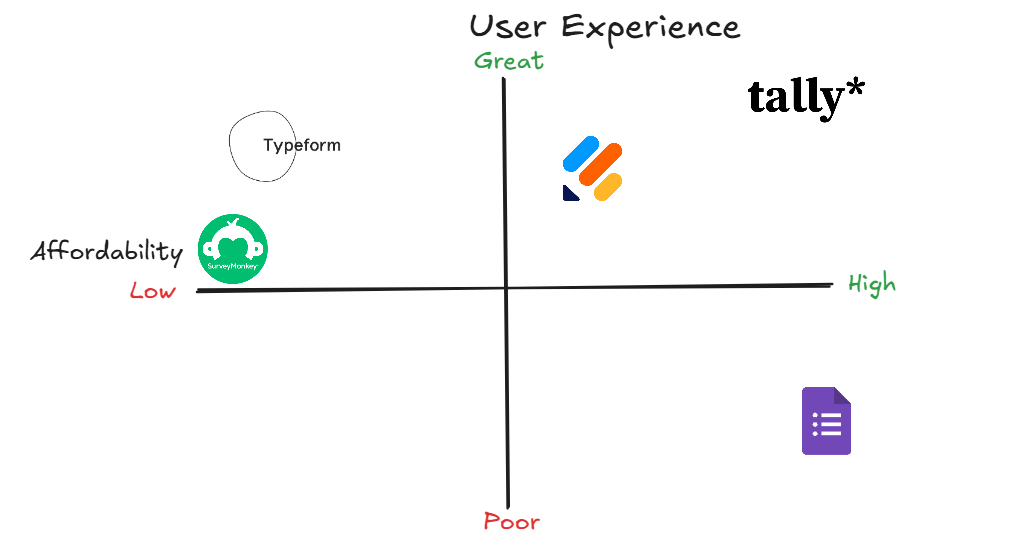
It’s true that Tally is in a competitive market, and they do have a lot more competition today than when they started, but when you zoom into their segment of the market, they are the clear winner.
This positioning wouldn’t work for a VC-backed startup, but its perfect for a bootstrapped, small team that can stay patient long enough to build incredible leverage from a large free user base.
Tally’s pricing model is brilliant and a major competitive advantage
If you visit Tally’s pricing page you’ll immediately notice something a bit different about it compared to most pricing pages.
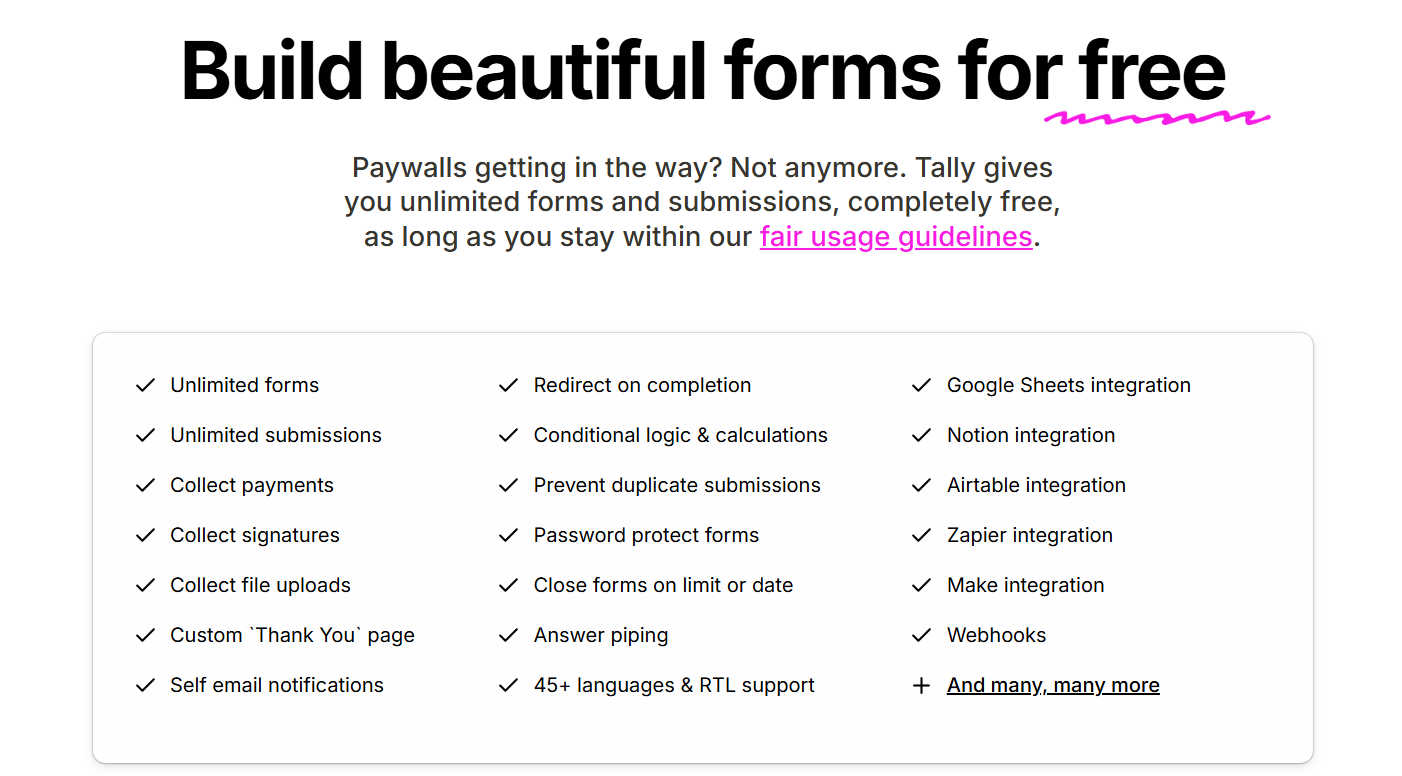
The emphasis on “free” can’t be missed and they are clearly proud of all the value they provide in their free plan, but take a look at the first two items listed in the block.
Tally offers unlimited forms and unlimited submissions in their free plan!
For comparison, let’s take a quick look at the pricing of two Tally competitors, Jotform and TypeForm.
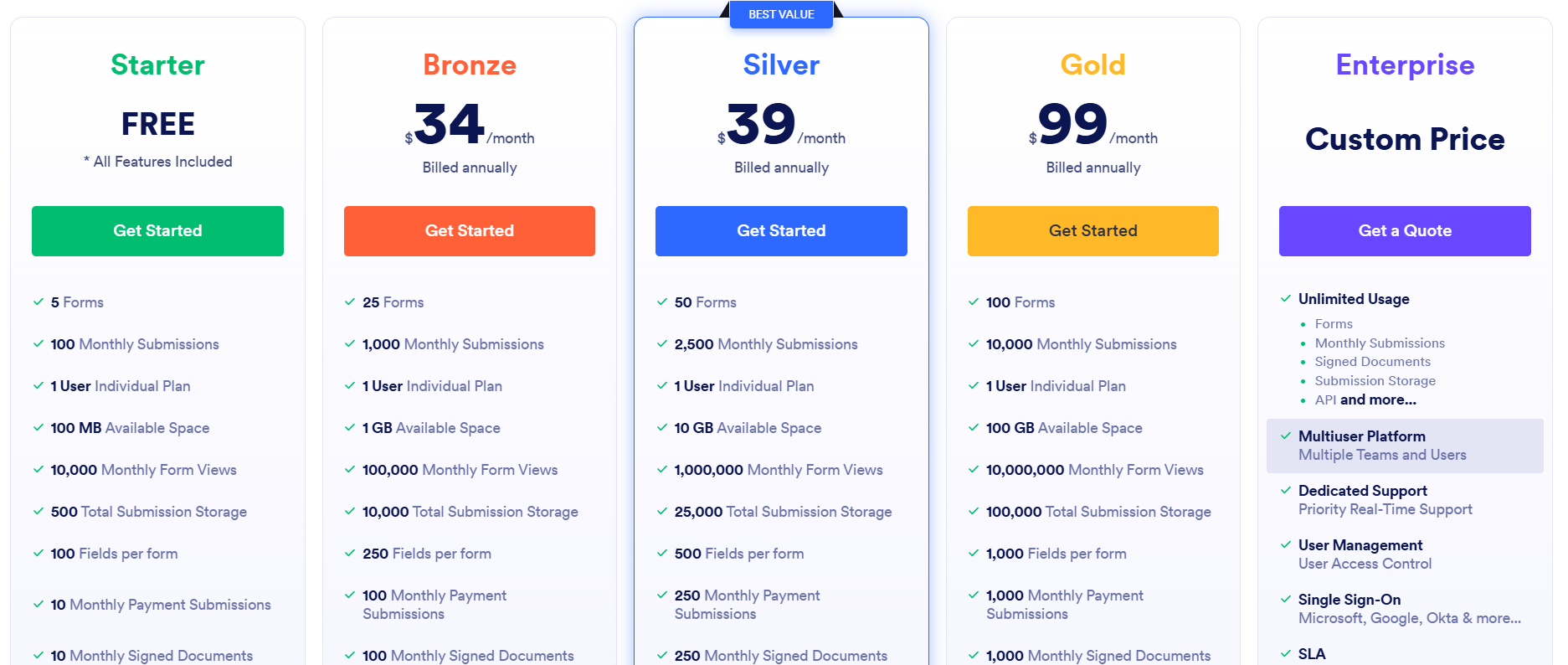

Both Jotform and TypeForm have strict usage-based limits across their pricing plans. Basically all the major form builders have usage-based limits.
Tally took a completely different approach.
Once again we see an example of aligning variables correctly. Tally could take this drastic approach because they are bootstrapped and playing a very different game to that of the average competitor.
Tally was playing a very long game and could essentially survive with very little revenue for a long time while they waited for their flywheel to gather speed.
What’s even more crazy about Tally’s pricing is that most of the advanced features you’d expect in a paid plan is included in their free plan.
This includes conditional logic, file uploading, integrations with Stripe and Zapier, password protected forms, and many other advanced features.
About 2% of Tally’s free users upgrade to one of their 2 paid plans, Tally Pro or Tally Business.
This is a low conversion rate for a B2B SaaS but it really doesn’t matter. Tally is playing the “big numbers” game.
By having just 2 paid plans, Tally keeps it simple. There is also a clear focus on Tally Pro which has far more features than Tally Business.

Removing the Tally branding, advanced customization, being able to invite the team, and custom domain support are by far the strongest features in the paid plans.
Tally Business has some features which will be important to European enterprises in particular (“control data retention” and “version history”), but overall it’s quite a weak offering when compared to Tally Pro.
I don’t think this is a bad thing overall since Tally is targeting the mass market and Tally Pro provides 95% of what an online business will ever need in a form builder.
I want you to notice that Tally Pro is $29 a month. You might be thinking, “why didn’t Tally offer lower pricing if their whole strategy is based on signing up a lot of users and converting a small percent to paid?”.
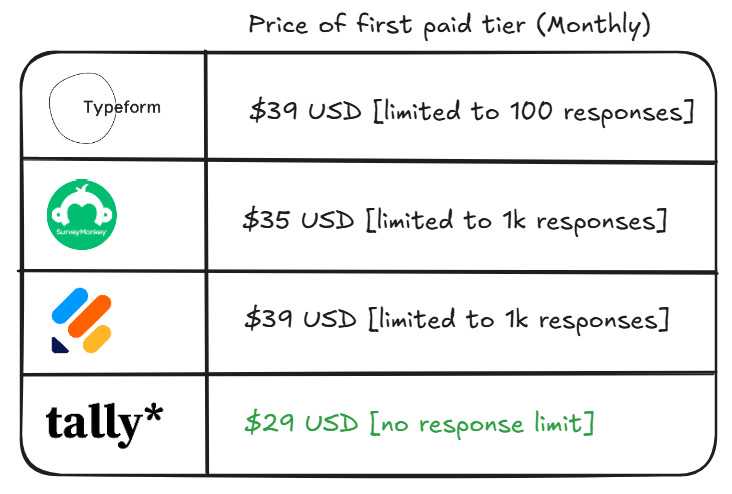
As the table above shows, Tally is perfectly priced and dropping their price would only result in less revenue for the company. If anything, they could raise their prices.
The table above is a bit misleading because Tally has no limits on responses, number of forms or team members while the other companies do. It’s not an “apples to apples” comparison which is a good thing for Tally.
Tally Pro is in a different league when compared to the paid plans in the form builder market. This is a strong competitive advantage.
Tally’s product development philosophy
One of the most common issues SaaS companies run into is building features that end up bloating the product and diminishing the user experience.
Tally hasn’t fallen into this trap and I was curious to understand how they avoided it.
During my research I came across an interview with Marie where she mentioned the following:
“And when it’s about the simplicity that’s just literally something that we ask, you know we survey our users twice a year, we have a customer satisfaction survey and we look for the ‘paper cuts’, so we don’t look for the new features because we know what the features are and we will build them at one point but we really look for the small improvements that you know increase the delight that make people love the product…” - Marie Martens, Co-founder of Tally
Tally’s product development philosophy aligns perfectly with the rest of the company culture which means more time spent focusing on what really matters.
There are two key pillars that make up Tally’s product development philosophy.
Pillar #1 - A user-first mindset
Tally’s product development philosophy ties back to their obsession with user feedback and building a world-class product.
Listening to users is a key pillar of their company culture and it shows in almost everything they do.
Below are just some of the ways the company prioritizes the collection of user feedback.
Collecting feedback through NPS surveys
Multiple times a year Tally sends its users using net promoter surveys (NPS).

This allows Tally to collect thousands of data points that can be used to judge their product development efforts since the previous survey.
Each time Tally runs their NPS survey, users can submit text-based feedback as well which helps the company identify patterns. This can help the team focus in on “paper cuts” which hurt the user experience.
All the NPS data is fed into Claude which helps with speeding up analysis.
Feature requests are handled through Userjot

Tally has a dedicated page on their website (https://tally.so/feedback/) for collecting feature requests from users.
Tally uses Userjot which is specifically designed for this purpose.
The company previously used Canny before Userjot but since Canny charges their customers based on the number of users that submit feedback, using Canny no longer made sense for Tally.
Office Hours
A more recent tactic used by Marie and Filip to gather user feedback is “Office Hours”, live group video sessions where users can ask questions, share feedback and engage with Tally’s founders.

Pillar #2 - Highly selective when it comes to product updates
A second pillar of Tally’s product philosophy is being highly selective when it comes to what is changed, or added, to the product.
For years the company focused on improving the experience of free users to help accelerate growth, until switching to building more premium features to help improve conversion from free to paid. Today it’s more of a mix but overall the focus on the user experience of free users has been prioritized.
The company publishes all their product updates in a public changelog which can be seen here - https://tally.so/changelog.
I took a quick look at their updates over the last 24 months and you’ll notice that the number of updates is relatively small but meaningful.
There have only been two updates so far this year (each update usually contains a number of changes and additions to the product).
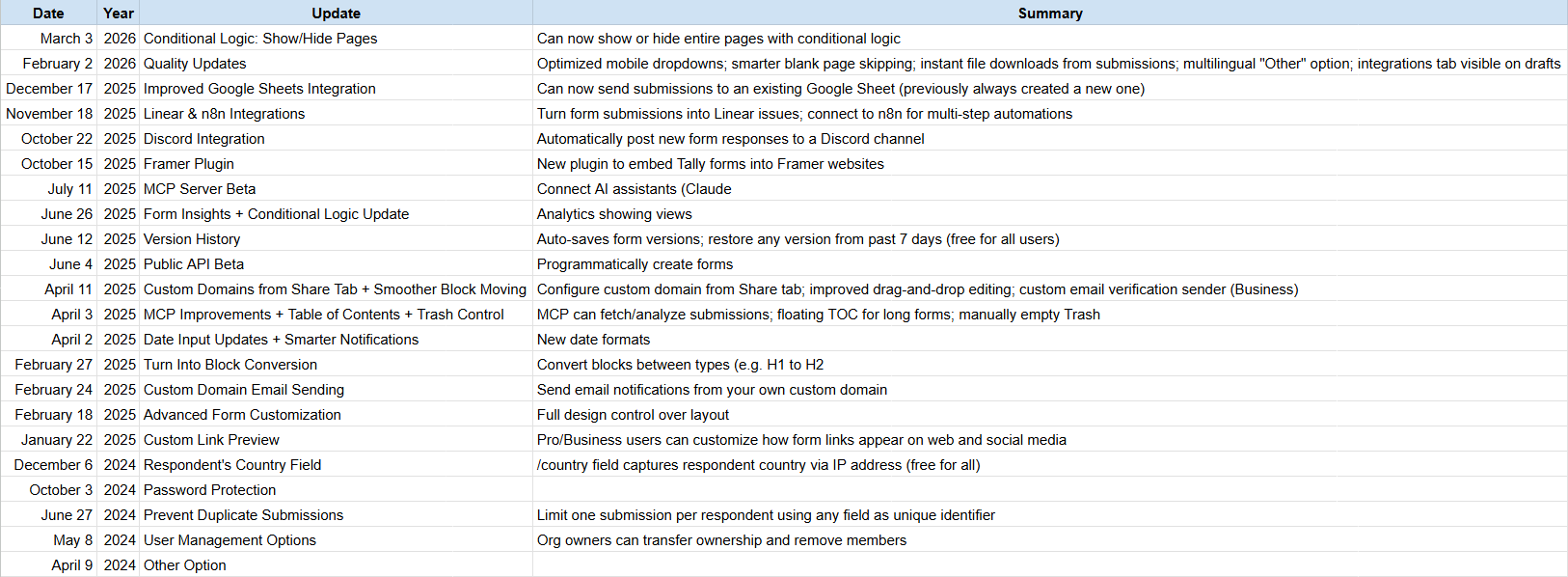
In the last 6 months the majority of the updates have been “quality of life” enhancements and new integrations.
For Tally it’s all about quality over quantity.
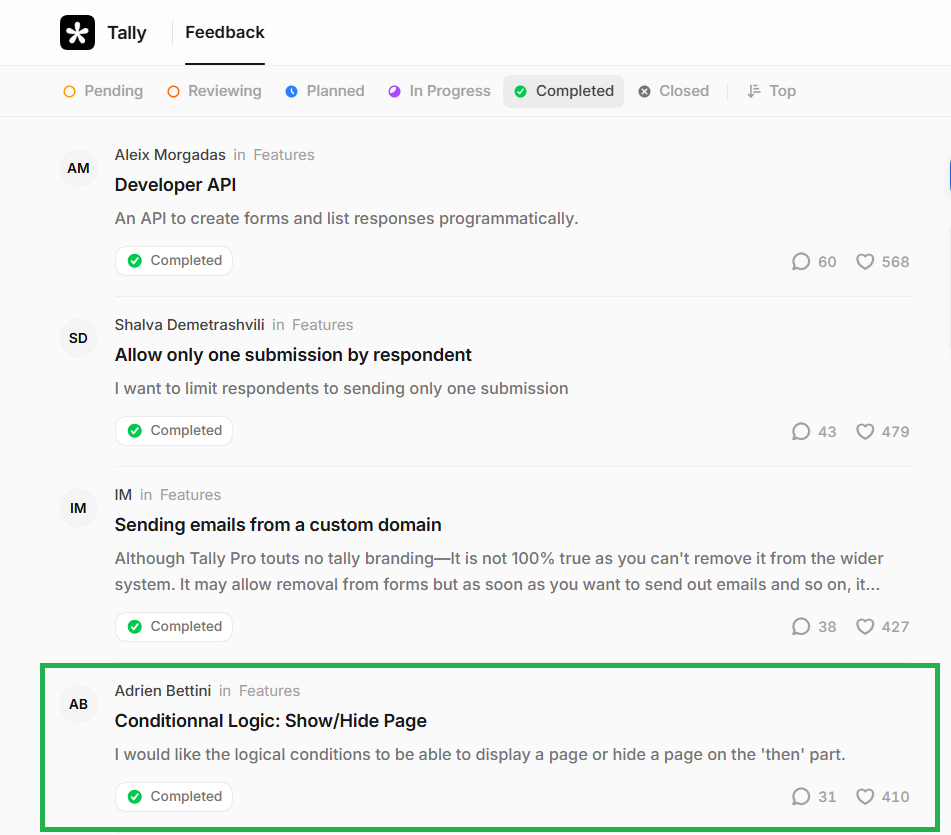
Notice how the conditional logic enhancement that went live in March was one of the most requested features in Tally’s Userjot board.
How Tally grew to over 1 million users
In 5 short years Tally signed up over 1 million users. This is an incredible feat for any SaaS company.
Let’s learn together how Tally grew to such a scale and adds over 100,000 users a month.
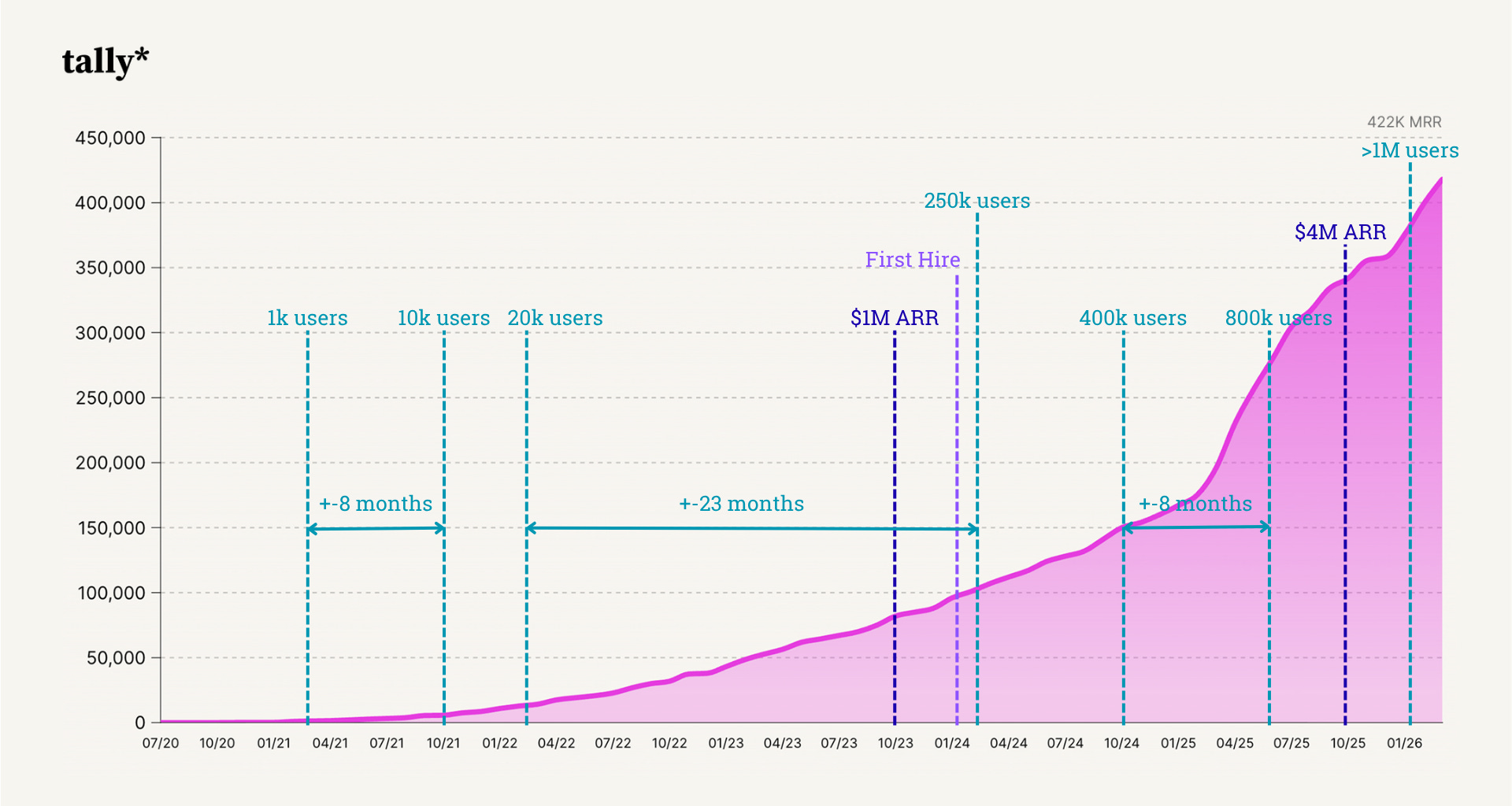
You can see in the image above that it took Tally over a year to get their first 10k users. The company added over 600k users in the last 14 months.
Tally’s growth strategy can be boiled down to three main components.
Component #1 - Product-led growth
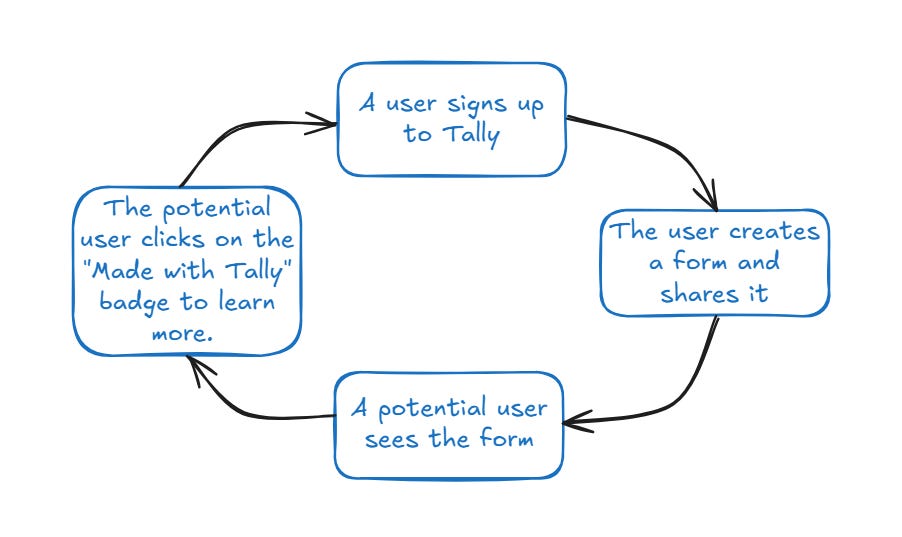
The usage-based flywheel
As a bootstrapped startup in a large competitive market, Tally’s decision to leverage product-led growth (PLG) is not only the right choice, but probably the single biggest contributor to their success.
Tally has a built in usage-based flywheel which means that each time someone fills out a Tally form they are introduced to the product.
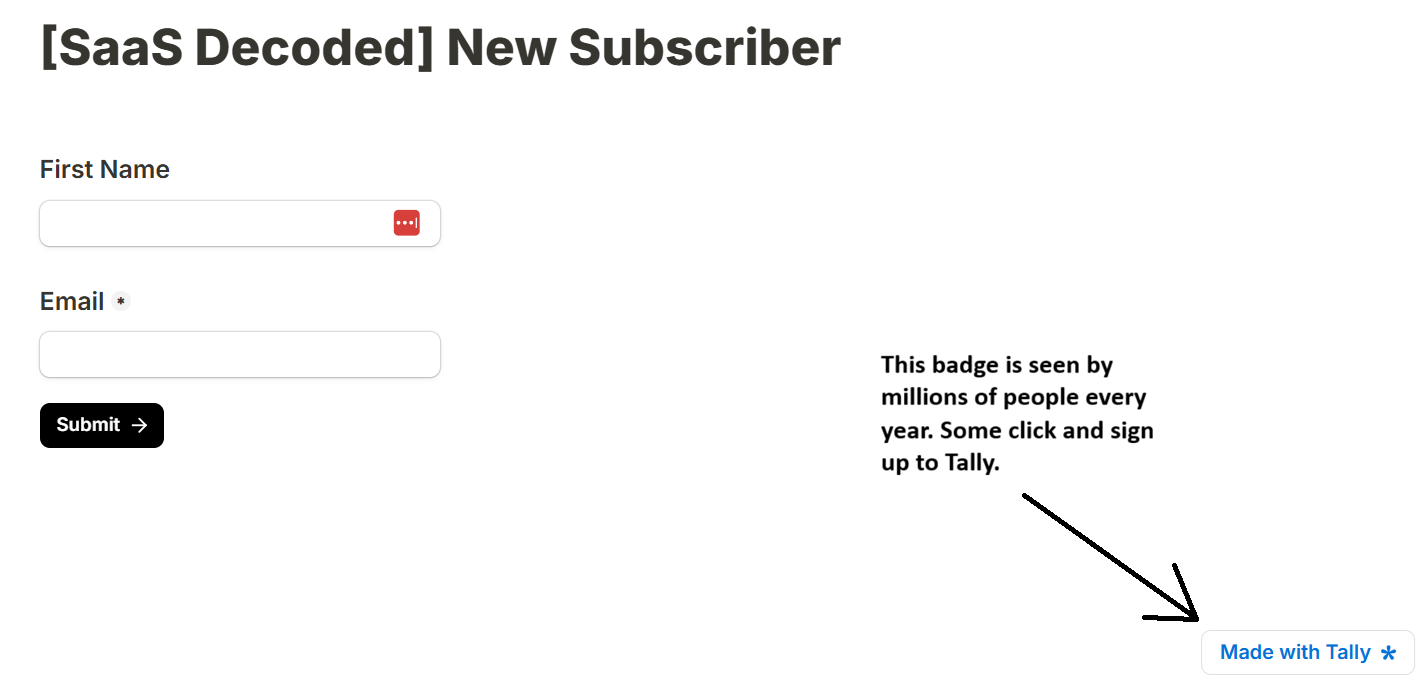
Each year millions of potential users are introduced to Tally simply by users using the product. As more users sign up and use Tally, so do more potential users get exposed to the product.
People are used to seeing ugly forms online so when they first see a Tally form, some of them get curious and click on the “Made with Tally” badge that appears on every form shared by a free Tally account.
Since Tally has the best free plan on the market by a long-shot, the barrier to sign up and try out the service is close to zero.
This simple flywheel is the single biggest contributor to Tally’s user growth.
A world-class, easy to use product leads to a lot of word of mouth
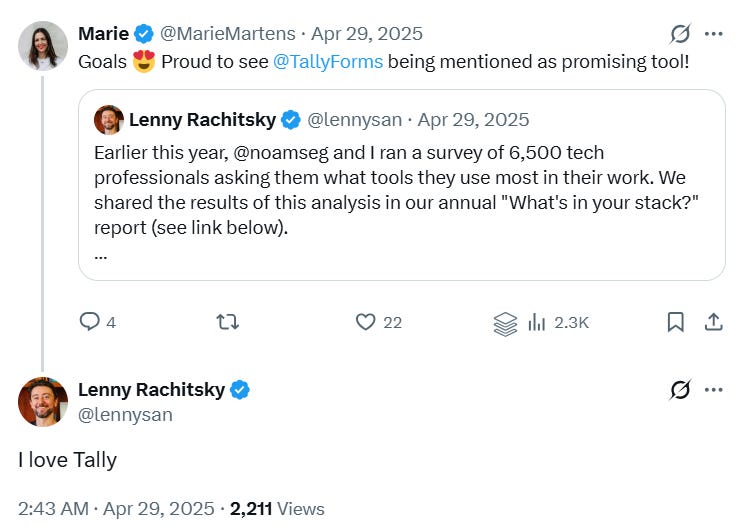
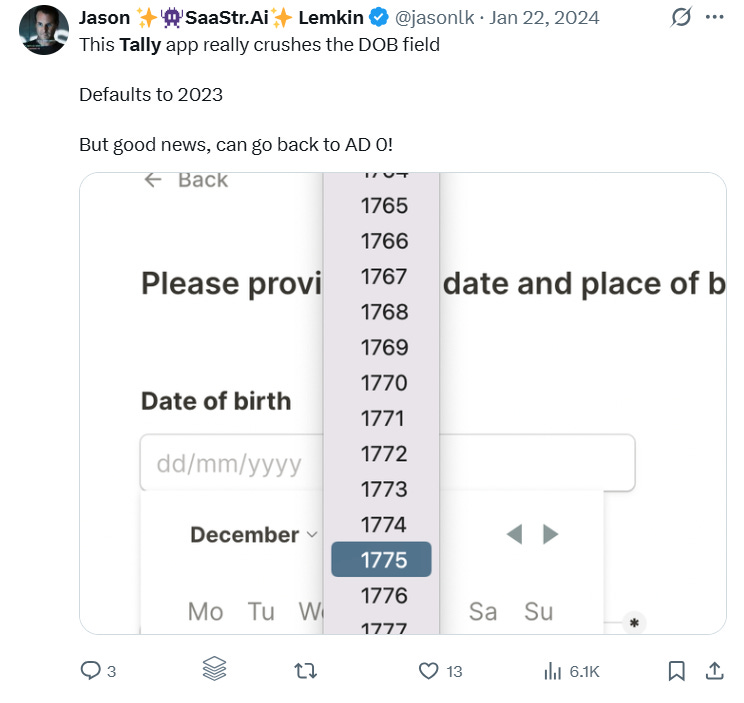
Just look at this snippet from Tally’s $4M MRR milestone announcement.
The more I dug into Tally’s story, the more I realized that this company is obsessively focused on building a great product.
Years and years of focused attention on building an amazing product leads to a raving fan base that promotes your product whenever the opportunity arises.

There’s something special about products which just work and are easy and fun to use.
Tally checks all these boxes and this leads to a lot of word of mouth. I’ve personally recommended Tally to many friends and fellow entrepreneurs over the years.
At scale this results in an army of evangelists marketing the app 24/7.
Component #2 - Community-led growth
From day one, Marie and Filip understood the importance of community, especially for gathering user feedback to help improve the product.

In the early days of Tally, every free user was invited to a Slack community where users could engage directly with the Tally founders.
After the community grew to a few thousand users the decision was made to hide the Slack community from the website and stop inviting new members.
In the video below, Marie goes into some details on the Slack channel and how it helped them gather feedback.
From my research I could also tell that community has become more of a focus for Marie and her marketing team, especially in the last 6 - 12 months.
There is a push for more in-person, community-related activities like meetups.


And more recently the company has been running “Office Hour” sessions where users can connect directly with Marie and Filip to share feedback, and ask questions.

So far there have been 3 “Office Hour” sessions and I assume this is going to become a semi-regular event.
These “Office Hour” sessions is just another great example of “doing things that don’t scale” that help Tally on its mission to provide the best form builder in the world.
By continue to invest in community, Tally is growing their fan base and helping to accelerate word of mouth. Since Tally already has such a loyal following, these efforts will result in outsized returns.
Not every SaaS can use community-led growth to help it scale. These tactics are best used by companies that are good at doing things that don’t scale, and already have a large, loyal fan base. Tally is perfectly positioned to double down on community-led growth to help push it towards $10M ARR.
Component #3 - Building in public
“Building in public” is a popular growth strategy used by indie-builders who share their story and “the grind” on social media as a form of marketing.
Marie and Filip have leveraged “building in public” from the very start of Tally’s journey.
Here are just some of the ways Tally leverages “building in public”:
Semi-regular blog posts sharing their numbers, areas of focus, goals and other company news.
Frequent updates on social media, especially on X and LinkedIn.
Marie has appeared as a guest on many podcasts where she shares Tally’s numbers, culture and tactics.
Being a speaker at conferences. Marie was spoken at Web Summit and MicroConf.
By being so open about their journey, Marie makes it easier for content creators to tell Tally’s story. I couldn’t have created such a detailed post if it wasn’t for all the time Marie invested in “building in public”.
I can only imagine the number of opportunities she has created for herself to further market Tally by being so transparent over the last 5 years.
Analyzing Tally’s MRR growth
Each time Tally hits an MRR milestone, Marie publishes a post on the company blog. This was a treasure trove of information that allowed me to plot Tally’s history and dig out a ton of important lessons.

In each MRR milestone post, Marie would include a useful graph showing Tally’s MRR growth.
Below is the most recent graph. To tell a more detailed story of Tally’s growth, I’ve added some key milestones to the image.
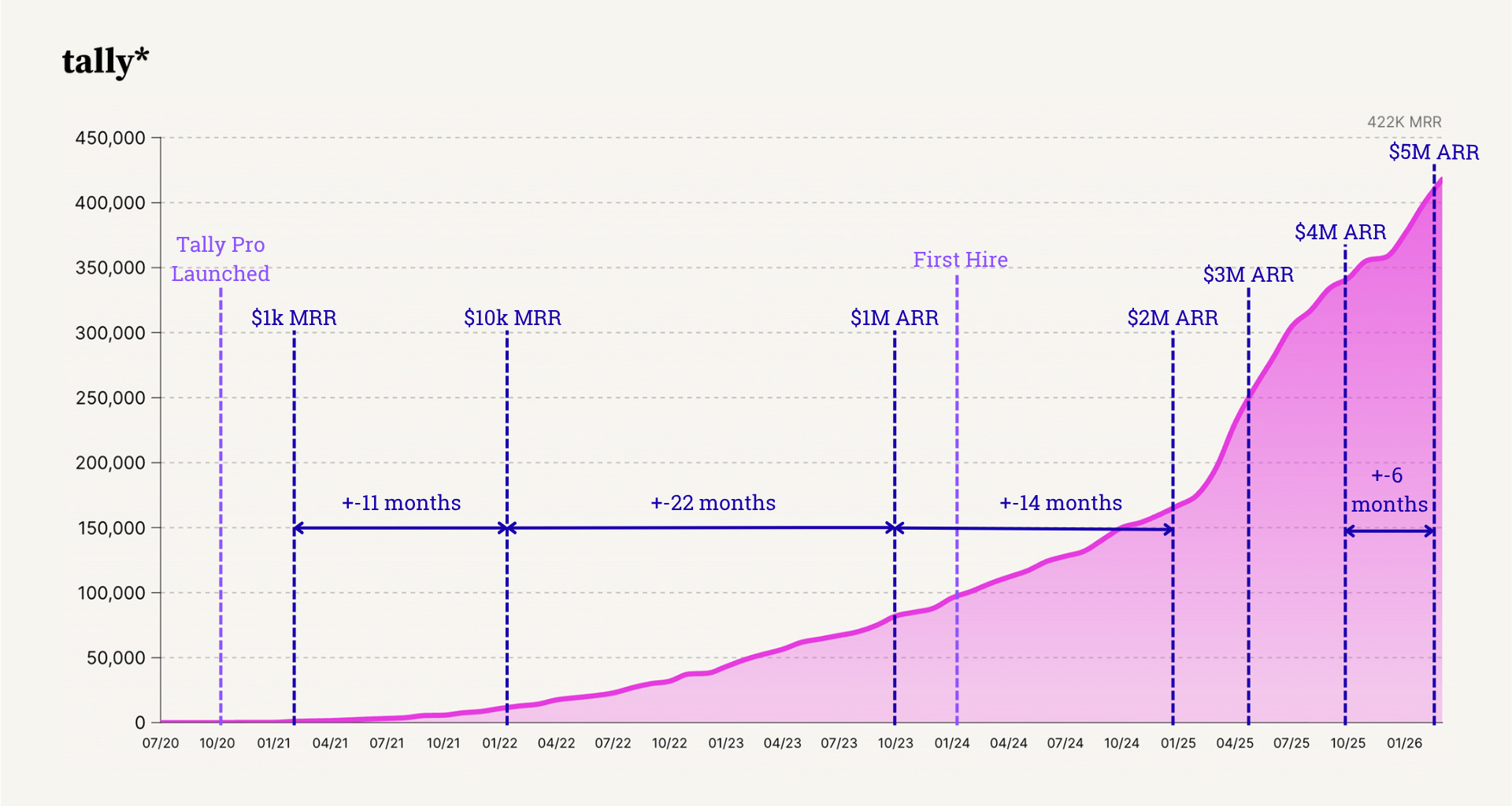
The first important insight is that Tally monetized early, just a few months after launching their MVP. Tally Pro launched in October 2020.

Bootstrapped startups can’t afford to delay monetization since bills need to be paid.
We can see from the graph above that Tally hit 1k MRR, the first important MRR milestone, in February 2021 about 6 months after launching their MVP.
A product hunt launch happened soon after which led to a nice boost in signups and revenue. According to Marie, their product hunt launch doubled their existing user base.
The next big milestone, 10k MRR was reached 11 months later.
22 months after that the company reached $1M in annual recurring revenue, just over 3 years from starting. The next million came just 14 months later.
We can see from my modified graph that Tally is now adding $1M in ARR in just 6 months. The exponential nature of their growth will result in this number dropping even further as time goes on.
The most incredible data point from the graph is that Marie and Filip went over 3 years without hiring any full-time help.
I couldn’t verify this but I must assume the company at least experimented with freelancers before making this first full-time hire.
To put things in perspective, the company was approaching 250k users by the time they hired their first full-time customer success manager.
By the end of 2025, the company had 12,000 customers.
Since we know the company was at +-$350k MRR, we can deduce that the average revenue per customer of Tally is $29.17, just a bit more than the cost of their monthly Tally Pro plan.
We can deduce further that the vast majority of their customers are paying for Tally Pro on a monthly basis.
The reason the average revenue per customer is higher than the cost of the monthly Tally Pro subscription is because some percent of the customer base is paying for Tally Business which starts at $89 per month. My guess is that it’s less than 10% of their customer base.
The last important question we need to answer when looking at Tally’s MRR growth, is what happened in late Jan of 2025 that caused such a sharp change in Tally’s growth curve?
The most relevant company update around this time is this one - From 2 to $3M ARR: How We Bootstrapped Tally With a Tiny Team.
In that update it’s mentioned that Tally shifted their focus back to building paid features after almost 2 years focused on improving the product for the free user base.
At that time the company also had 4 full-time and 4 freelancers on the team which most likely motivated the decision to shift back to focusing on monetization (since the company had to pay 4 employee salaries).
Another reason for the shift in the curve was Tally being recommended more in AI-driven search results.
ChatGPT became their #1 referral source and has continued as a relevant, and growing marketing channel.
Marie shares more details on this topic in the update post.

A summary of the key lessons from Tally’s journey to $5M ARR
There are many key lessons in the Tally story, especially for bootstrapped SaaS founders that plan to compete in mature, highly competitive markets.
Below I’ve summarized the 7 key lessons I learnt from analyzing Tally’s impressive journey to $5M ARR.
Lesson #1 - Make sure to align the main pillars of the business
The single most important lesson from the Tally story is that life becomes much easier when all the major pillars of the business are in alignment.
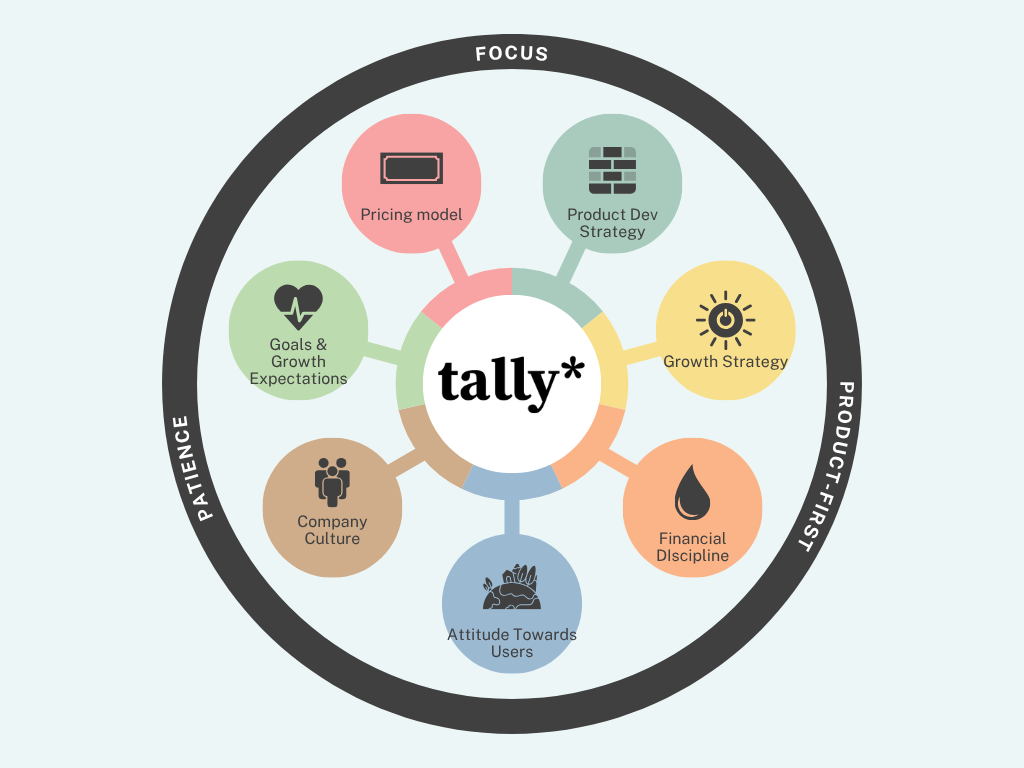
There are usually just a few critical decisions that entrepreneurs must get right to stand a chance of building a meaningful business.
Setting the right company culture, choosing a growth engine and pricing model, and setting the right expectations are a few examples.
Tally would be very different today if Marie and Filip went with a different pricing model, decided to raise funding, and set far more aggressive revenue goals.
Instead they’ve built an incredibly profitable business at their own pace under their own terms.
It’s possible to build a successful business in a highly competitive market
Many people would advice against operating in a large market with a lot of competition. I’m sure many people would have advised Marie and Filip against starting a form building business back in 2020.
Tally’s story shows us that it’s possible to compete in a highly competitive online market as long as you get a lot of things right, have incredible patience, and are willing to listen to the market.
Marie and Filip were able to validate their business in about 6 months, identify the most important things to focus on, and then they showed up every day for years.
Tally’s founders made a lot of smart decisions early on and managed to carve themselves a nice piece of the market and dominate it through years of hard work and focus. A lot of entrepreneurs can learn from this lesson.
Lastly on this point, a major advantage of competiting in a large market with a lot of players is that you know there is demand.
The number one reason tech startups fail is they try and solve a problem that either doesn’t exist, or the market won’t pay to have it solved.
Marie and Filip knew from day one that the market for forms was large enough for them to at the very least build a nice “lifestyle” business.
They set the right expectations for themselves and got to work.
Have one clear growth engine
The vast majority of Tally’s users learn about the service by viewing forms shared by Tally users.
Tally identified this usage-based flywheel early on and have stayed focused on improving it by systematically enhancing the user experience one small update at a time.
SaaS founders need to understand where users are going to learn about their products and dedicate a disproportionate amount of resources to build and enhance their primary growth engine once identified.
Bootstrapped founders need to be product obsessed since word of mouth and PLG is their best bet to reach scale without a large marketing budget.
Having a narrow focus is also the best way to outcompete much larger competitors.
It’s possible to reach scale with a small team
Marie and Filip operated Tally for years without any full-time team members.
The company has had a very high ARR per employee for years and will continue to increase this ratio as exponential growth continues in the years to come.
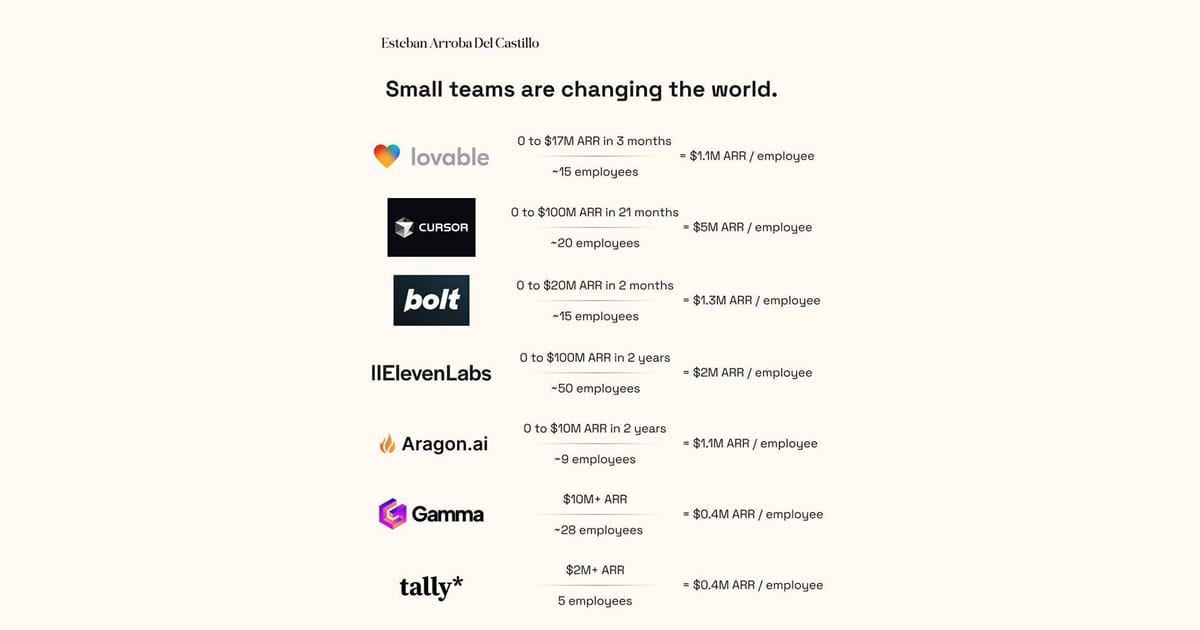
Marie did mention that her biggest mistake while growing Tally was hiring too slowly.
I think Tally is an extreme case, especially over the first 4 years of their history, but their story does show us that it’s possible to reach millions in ARR with a handful of dedicated team members.
In the AI era this will become even more common.
There’s a difference between a product and a platform
Marie makes it very clear that the company views itself as a product, not a platform.
It’s very tempting to build more and more onto your product so that it ends up becoming a platform, or entire ecosystem, but Tally isn’t interested in that.
The company has a clear mission and it can only achieve that mission by staying focused and keeping things simple.
Do things that don’t scale
There are many examples in Tally’s history of the founders doing things that don’t scale.
From cold emailing potential users to help validate the business, to inviting individual users to a Slack community; time and time again the Tally founders have taken deliberate action which is not scalable.
I was quite shocked during my research when I learnt about the relatively new “Office Hours” that Marie and Filip were running. At over $4M ARR the founders were hosting video calls with as few as 20 users at a time.
Which entrepreneurs do that?
Only those that understand that sometimes you need to do things that don’t scale because you just might learn something.
Leverage + time = exponential growth
One of the most incredible data points from the Tally story is that it took the company 3 years to reach $1M ARR and they now add $1M ARR in less than 6 months.
I purposefully included the time it took for Tally to reach certain milestones in the graph above to show how SaaS scales exponentially.
Since Tally’s growth comes from their high leverage, usage-based flywheel, the longer the company is around the faster it grows.
As long as metrics like their free-to-paid conversion rate, churn and pricing stay consistent (or improve), the company will continue to scale faster. The market for forms is so huge that Tally has many years of growth ahead of it.
That’s it for this week. Thanks for reading and I’ll see you in the next one.
Justin
PS: Did you enjoy this post and don’t want to miss my next one?
Go ahead and enter your best email below and click subscribe. I publish one deep researched post every week.
*Tally is one of 5 SaaS apps that are included in the launch version of The Vault, a free benefits program for SaaS Decoded subscribers.
If you click on the first link to Tally in this post (or here), and decide to upgrade to Tally Pro, you will get 50% off your subscription for the first 3 months. I will earn a small percentage of your spend up to $150.