

Hey friends,
I started to use Stripe back in 2022 when I made my first SaaS acquisition.
Four additional acquisitions, over 6-figures in SaaS revenue, and years managing hundreds of subscriptions has taught me many interesting lessons.
In this post I’m going to share with you some of the advanced concepts I’ve learnt working with Stripe.
Lets jump right in.
Advanced concept #1: Stripe can be used to track multiple steps in the core funnel
The core funnel is a product analytics concept I first covered in my BI blueprint for early-stage SaaS post.
In a nutshell the idea behind the core funnel is to map the major steps in the user’s lifecycle and structure it as a funnel.
In the video above I share a very standard “core funnel” of:
Signup —> Completed onboarding —> Wow moment —> Started trial —> Paid —> Paid again.
Payment service providers (PSPs) are typically the source of truth for later stages in the core funnel, namely “started trial”, “paid”, and “paid again”.
Stripe can however be used to cover more steps in the funnel, even the first step, signup.
Stripe in of itself is structured kind of like a funnel. The first entity that is relevant is “customer”.
A customer in Stripe then gets a subscription which has a payment method. Invoices are then created for the subscription and finally we have transactions which are related to invoices.
It’s possible to set up your apps backend so that when someone signs up, or installs your app, like in the case of a Slack app, that they are created in Stripe as a “customer”.
I have a number of Slack apps that are set up this way which means that I can easily see how many new, unique Slack workspaces have installed my apps directly in Stripe.
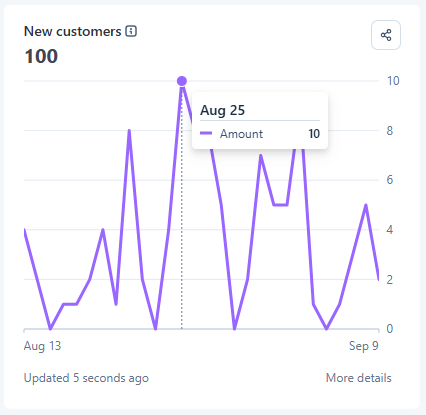
There’s really no down side to push new signups into Stripe. It really comes down to how you define things internally.
You may prefer to define “customer” as someone who has entered their credit card; in which case you create the Stripe customer record at that point in time and not earlier.
I think this approach works best for marketplace apps like Slack apps where you expect the user to interact with your app within the host platform, and not your own web-based interface.
Advanced concept #2: Churn trend analysis, and MRR “bleed”
Many SaaS founders don’t truly understand the difference between churn rate, new MRR, MRR “bleed” and net MRR growth.
Thankfully Stripe gives us the tools we need to make sense of all these numbers.