

Hey friends,
About 2 weeks ago I published part 1 of my new series, $0 to $10k MRR. In that post I shared the idea for a new SaaS I was building called Project Logbook.
I’m a bit embarrassed to report that I’ve already shut down Project Logbook.
A few days after building the MVP (and sharing it with you in this newsletter), I realize that it was a silly idea.
For some reason the idea behind Project Logbook entered my brain and wouldn’t leave. I jumped the gun on an idea which goes against so many entrepreneurial principles that I believe in.
There are three major issues with Project Logbook that I’ll share with you briefly.
No existing market - The idea behind Project Logbook is “innovative” and “unique”. This makes it highly risky and far more difficult to make work compared to building in an existing market.
Trust - In order for Project Logbook to work, you need to connect all your business tools to the platform. This means sensitive data is being recorded at scale. I would need to build up significant social proof before people would trust me enough to use the service. This just adds to the difficulty factor.
It’s a nice to have - Is Project Logbook solving a real problem? Not really. No one across my entire audience should any interest in Project Logbook. Once again, when you’re building something brand new there is a high chance there’s no demand for it.
The silving lining is that I identified my mistake early and took the correct steps. Today I pulled the plug and turned off Project Logbook.
The cost: 2 days of my time, about $50 in expenses, and some “egg on my face”.
Introducing Project Echo
So here’s the good news. I’ve already decided on a new SaaS and I’ve made significant progress building the alpha version.

The new SaaS I will be building (and sharing the full journey to $10k MRR in this series) is Project Echo, a user feedback management tool built for SMB and Midmarket SaaS businesses.
Some of you reading this will be saying to yourself, “another feedback solution?”, and the answer is yes (and that’s the exact point). I’m done building “new” things which require market validation. I’m now a “cloner”.
The idea is to completely eliminate the questions, “does this solve a problem?”, and “will people pay for this?” from the equation.
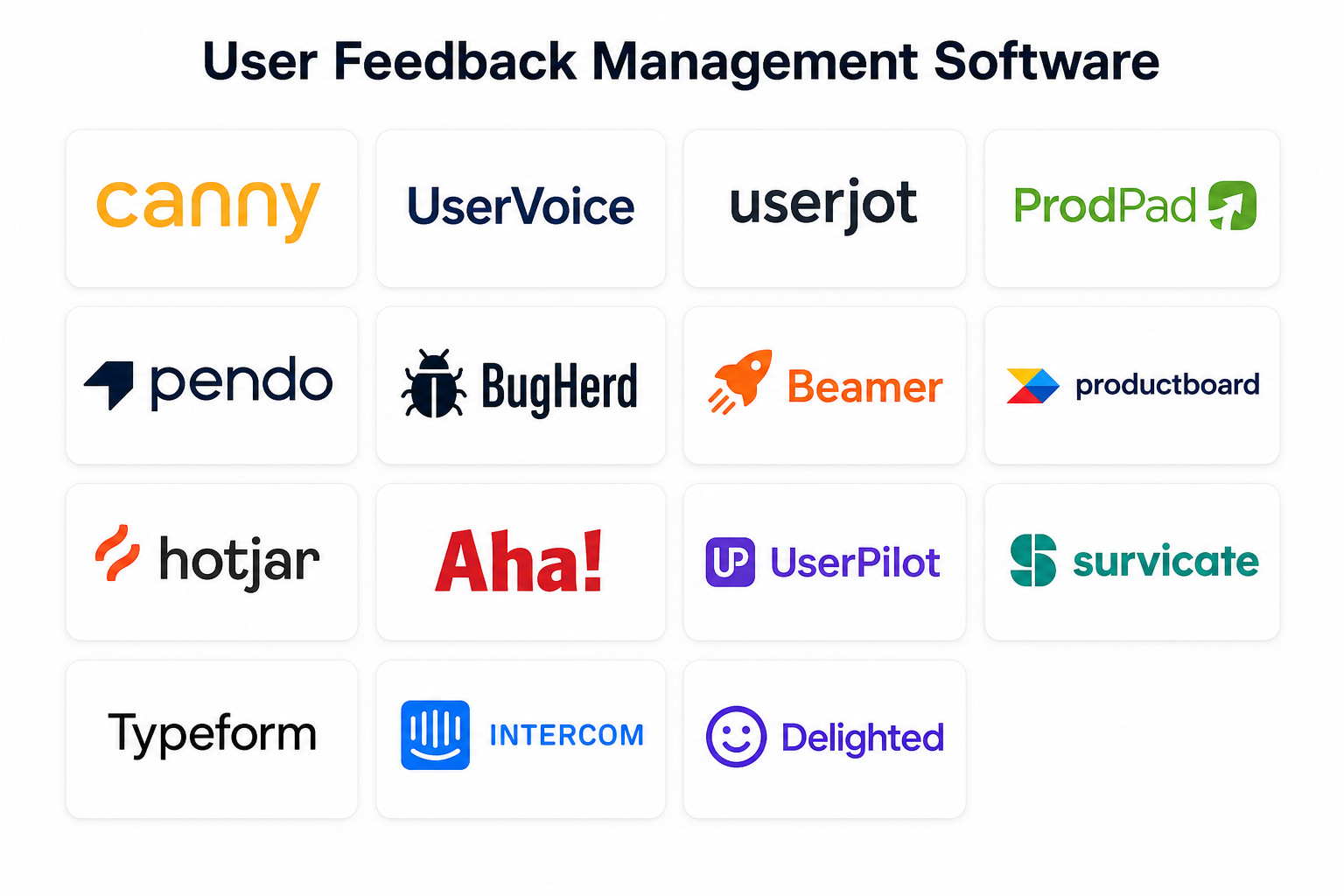
The user feedback tool market is well established with a lot of players. This means there is an existing market and companies are willing to pay for the value these tools provide.
It’s “evergreen” and a growing market (now that it’s really easy to make SaaS).
Instead of jumping head first like with Project Logbook, this time I ran the idea through a checklist.
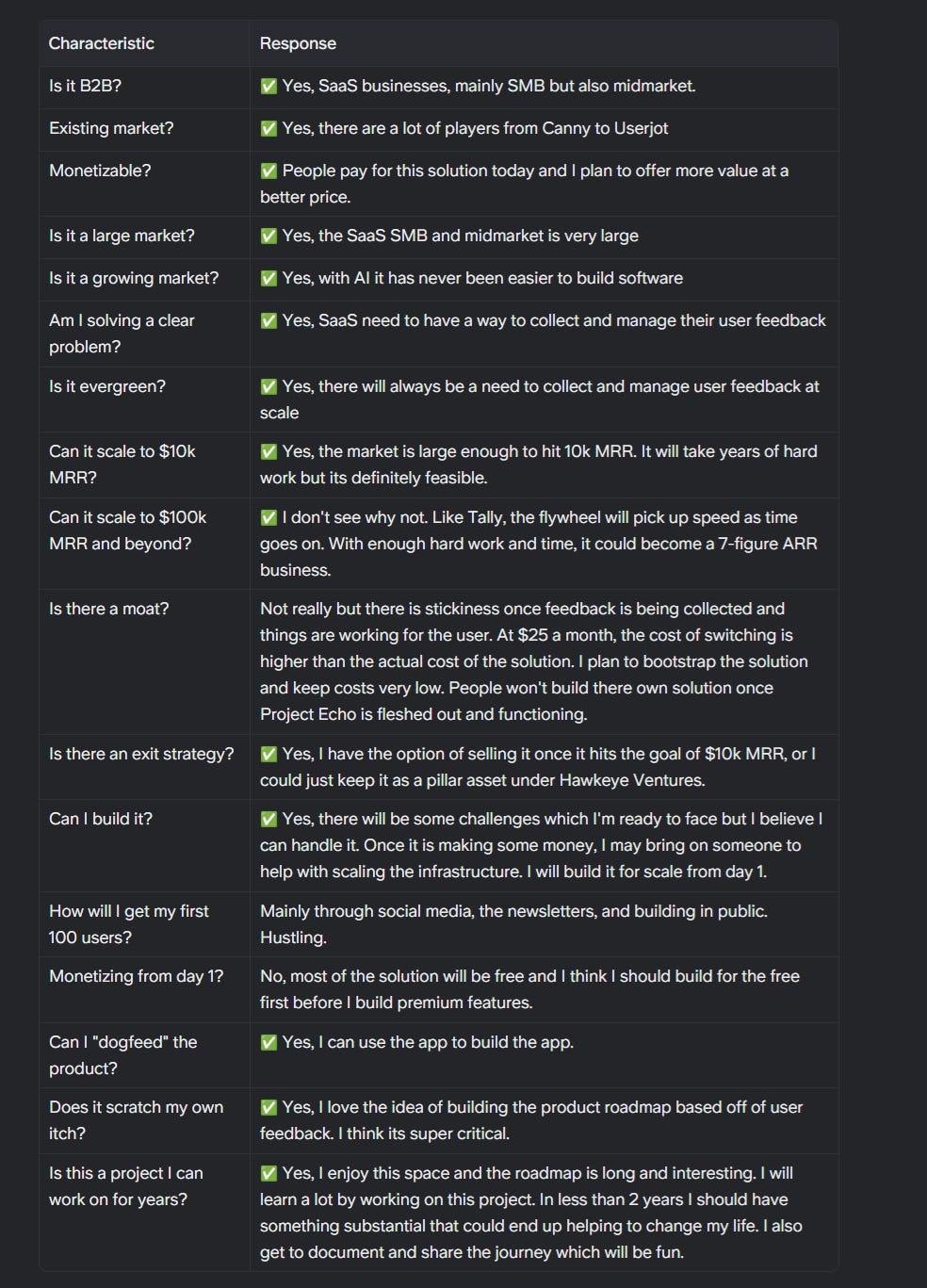
I’ve always been a fan of this market. I used UserVoice at my previous company over 10 years ago, and more recently I’ve recommended Canny to my SaaS clients.
A few years ago I almost acquired a SaaS operating in this market but unfortunately it didn’t pass my due diligence.
I decided on the name Project Echo simply because I already owned the domain and the term “echo” fits nicely.
So you’re just going to clone Canny / Userjot? How will you differentiate yourself?
In short, yes, but I do have three ways I will differentiate Project Echo from the rest of the solutions in this market.
Differentiator #1 - An extreme free plan
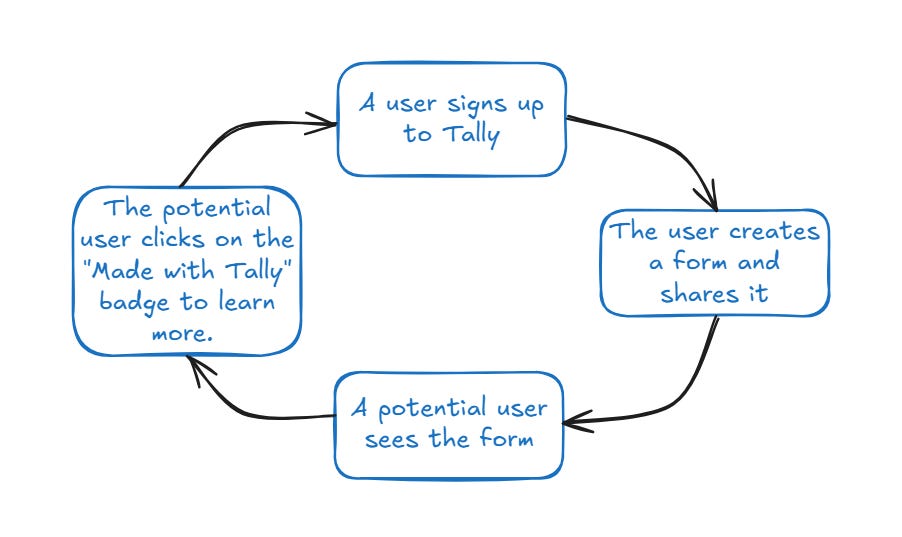
The main differentiator is an extreme free plan. I’m adopting the “Tally playbook” by offering unlimited usage and most features for free.
This strategy will help drive word of mouth and a bigger top of funnel while resulting in a lower conversion to paid and more support. I think this is a good trade because it ties into my advantages.
Like Tally, I will be bootstrapping the SaaS so I need to build leverage wherever possible. I can use product-led growth tactics to build a usage-based flywheel that will market the app to more potential users as the user base grows.
Another big advantage I have is that I don’t need Project Echo to pay my bills. I can take my time and enjoy the process building the platform, brand and everything else that goes into taking a SaaS from $0 to $10k MRR.

I’ve already listed the features that will be included in the free and paid plans on the Project Echo landing page since this is the biggest hook I have at this point.
Project Echo’s paid plan (pro plan) will be $25 a month, or $250 a year, a bit below the market average of $29 a month for the first paid tier.
Unlike my competition, I will have just 2 plans, a free and pro plan.
The biggest draw for the paid plan will be removing the branding, custom user and company properties, and MRR attribution.
Differentiator #2 - Implementing the best from the market
When analyzing the different solutions in this market, you’ll notice slight differences in positioning. Canny, Pendo and UserVoice aim for larger businesses and price accordingly. Userjot, Nolt and most the market, target SMBs and price themselves at around $29 a month.
Most of the players in this space offer the same core features but there are examples of more advanced features which haven’t been widely adopted.
One example is user segmentation and reporting. Canny does a great job offering these features but for some reason they haven’t been widely adopted in the market.
I will take the best features I find across the market and implement my favorite in Project Echo.
Differentiator #3 - My own unique spin
The last way Project Echo will be different from the rest of the market is by doing things my own way. I’m taking a lot of inspiration from Userjot and Canny but I have my own ideas which will go into Project Echo’s development.
A great example is the implementation of card ordering by “drag and drop” in the roadmap section. Userjot doesn’t offer this functionality which is an oversight in my opinion. I want to be able to order the requests by priority within each status column.
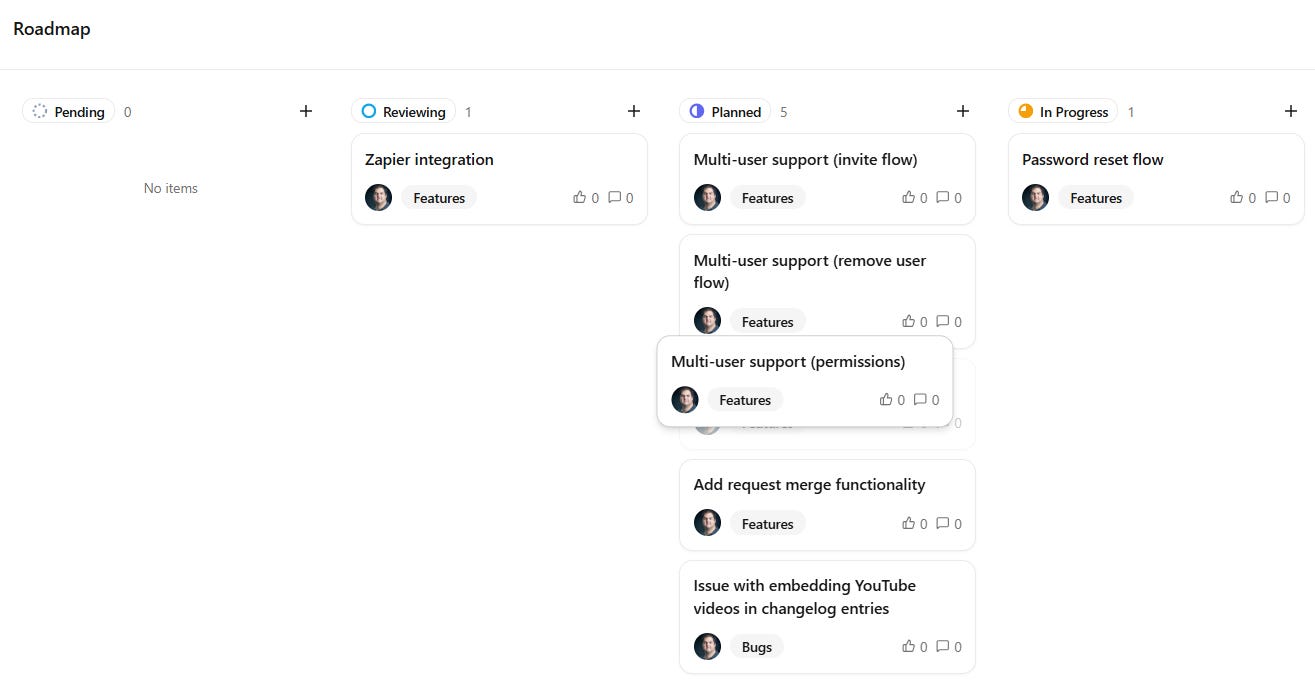
I have many ideas for Project Echo but I’ll just share two I’m excited about:
MRR attribution - Tie feature requests to existing MRR (through an out-of-the-box Stripe integration) and see how much is at “risk”. Canny does this today to some extent but I believe it can be done better.
Out-of-the-box user and company properties - Adding custom user and company properties is a paid feature among most solutions in this market. I plan to do the same but offer more out-of-the-box properties which free users can leverage on day 1.
I also have some more risky ideas that I may share at a later stage. I don’t want to get too carried away and it’s important that I’m “dogfeeding” my own product and listening closely to users.
The economics behind Project Echo as a business, and other important considerations
Since the immediate goal is to build Project Echo to $10k MRR, let’s run some numbers.
Assumptions:
Conversion from free to paid - 2.5% (Tally has a conversion rate of 2%, my market is wealthier so I expect it to be higher than 2% but I’m being conservative).
% of customers on a monthly plan - 80%
% of customers on an annual plan - 20%
Cost of a monthly plan - $25 ($25 MRR)
Cost of an annual plan - $250 ($20.83 MRR)
Average MRR per customer - $24.16
Monthly churn rate - Hard to say. I expect a strong cohort (mature SaaS) that basically never cancel, while many newer SaaS that decide to make the leap to paid that stay 2 - 6 months and count for most of the churn.
So in order to hit $10k MRR, I’ll need +-414 concurrent active subscribers. At a 2.5% conversion from free to paid, that means I’ll need 16,500+ users. This assumes zero churn so the real number is quite a bit higher.
These are all assumptions at this point but I can say for sure that I’ll need to support a lot of users in order to grow Project Echo to 5-figures in monthly recurring revenue.
I know this will take years of hard work.
Risk factors
All business ventures have risk. The main risks I see with Project Echo are:
Low ticket will make it hard to scale - Ideally when you’re building B2B SaaS, your ARPU is above $50. Mine is less than half of that which will make it tougher to scale. Project Echo’s infrastructure costs will also be higher than most SaaS as the user base scales because much of the product can be exposed to the public (public portal), not to mention the on-site widget embedded within users’ apps.
Competitors come in and push prices down - Once more people understand what I’m doing, I’ll inevitably spawn my own copycats. As competition in a market grows (supply), the piece of the pie shrinks for everyone operating in that market. There will be little to stop people coming in and offering similar solutions for an even lower price. The way to combat this is just by being better at the competition. I also believe that $25 a month is close to the realistic bottom for running the business profitably at a sustainable rate.
Technical risk - This is a real risk that I’m taking seriously. I’ve already built around 40% of the basic platform but I’m leaving the most complex pieces (the on-site widget, user tracking, and integrations), to the end of the alpha build. I’ve also made sure that Cursor and I are building the platform for scale from day 1. I imagine that sooner or later I’ll need to bring in someone with actual devops / scaling experience to help me optimize the infrastructure for increased scale.
Overall the risks I see are minimal and there are no major blockers holding me back from moving forward. The upside is massive and I can now rest easy knowing I’m building a solution in a large market with real demand. Now it’s all about execution, building a world-class product, and getting it in front of tens of thousands of potential customers.
I’ve positioned myself well for learning a ton, sharing an exciting journey, and for building a revenue stream that could change my life.
So what’s the state of the product?
So far I’ve spent about 15 hours vibe-coding Project Echo and I’ve made tramendous progress.
Basic functionality for admins is already in place and at my current pace I expect to have an alpha version ready in under two weeks.
The homepage is live and you are welcome to join the waitlist so you’re the first to know when the app is ready for you to sign up.
I’m already using the product to build the product which is a lot of fun and important for me to go through and enhance the user experience.

The public portal is almost ready and I’ll most likely share it in the next part in this series so you can follow along with the development of Project Echo.

That’s it for this week. Thanks for reading and I’ll see you in the next one.
Justin