

Hey friends,
Welcome to part 4 of my $0 to $10k MRR series.
If you are new to SaaS Decoded, or haven’t yet heard of the $0 to $10k MRR series, you can find the first three parts listed below.
![[Part 1] $0 to $10k MRR: Idea, Foundation, and MVP](https://substackcdn.com/image/fetch/$s_!us6c!,w_140,h_140,c_fill,f_webp,q_auto:good,fl_progressive:steep,g_auto/https%3A%2F%2Fsubstack-post-media.s3.amazonaws.com%2Fpublic%2Fimages%2F68c42968-31b0-4cfd-903d-e52507cb26f2_1258x678.png)
![[Part 2] $0 to $10k MRR: The reset,checklist, and waitlist](https://substackcdn.com/image/fetch/$s_!JD81!,w_140,h_140,c_fill,f_webp,q_auto:good,fl_progressive:steep,g_auto/https%3A%2F%2Fsubstack-post-media.s3.amazonaws.com%2Fpublic%2Fimages%2F7a21626b-738f-4900-aba6-adc9f6af3984_983x639.png)
![[Part 3] $0 to $10k MRR: The alpha launch, "dogfooding" your product, monetization and early ops](https://substackcdn.com/image/fetch/$s_!sVee!,w_140,h_140,c_fill,f_webp,q_auto:good,fl_progressive:steep,g_auto/https%3A%2F%2Fsubstack-post-media.s3.amazonaws.com%2Fpublic%2Fimages%2F49413475-5140-452b-b6d8-cffed5cf8475_1393x727.png)
The Project Echo platform continues to take shape. I managed to dedicate 3 sessions this past week to vibe-coding and I’m really happy with the progress I’ve made.
A lot of the new features and enhancements I built are things I wanted myself as a user of Project Echo.
One example is being able to change the board of a request directly on the requests page.
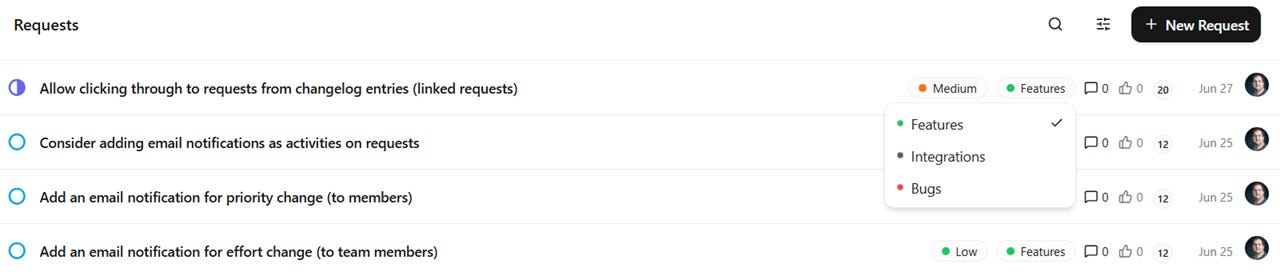
Before this change you’d have to click on the request, then change the board, and then click back. 4 clicks have been reduced to 2.
You’re welcome to read the latest changelog entry to see the latest updates.
Radical transparency
One major piece of work I focused on this past week was building the “Open” page for Project Echo.
I decided that since I’m building Project Echo in public, I might as well take it to the max and treat Project Echo as an “open startup”.
If you aren’t familiar with the concept of an “open startup”, spend a few minutes reading up on Buffer. You’ll quickly learn that they take radical transparency to the extreme, even to the point where their entire team’s salaries are made public.

The obvious question is why would a company do such a thing? Why share your private information to the public so your competition knows how your business is performing?
I think the answer comes down to a risk vs. reward equation that companies like Buffer have calculated, and they’ve come to the conclusion that the upside exceeds the downside.
In short, being an “open startup” helps drive more attention since people rarely get to see what’s going on under the covers.
From my standpoint I really have nothing to lose. I’m a solopreneur who is bootstrapping Project Echo so I need to use everything I can to get the word out, especially in the early days.
I’m also a believer that there isn’t enough useful information being shared by operators in general.
So many entrepreneurs are taking advice from gurus and influencers who either never accomplished the success they speak of, or are so far ahead that their advice is hard to connect with.
I want to share the reality of what it takes to build a $10k MRR SaaS from scratch and to do that I’m leaning into radical transparency.
The “open” page of Project Echo will be like a journal sharing the full history of the SaaS.

The “Open” page of Project Echo shows the real, up to date numbers of the SaaS, from the number of workspaces in the database, to the number of active subscribers (none yet). I will be adding more numbers over time such as website traffic, certain conversion rates, churn, LTV and others.
I’m also sharing the changelog entries so anyone can see how the product evolves over time. I’m using Project Echo’s changelog for this purpose (“dogfooding” the product).
The most important section in the page is the milestones section.
In this section I will be recording the exact dates when the SaaS hits certain milestones. This will help my fellow entrepreneurs know how long it takes to reach certain points along the journey.
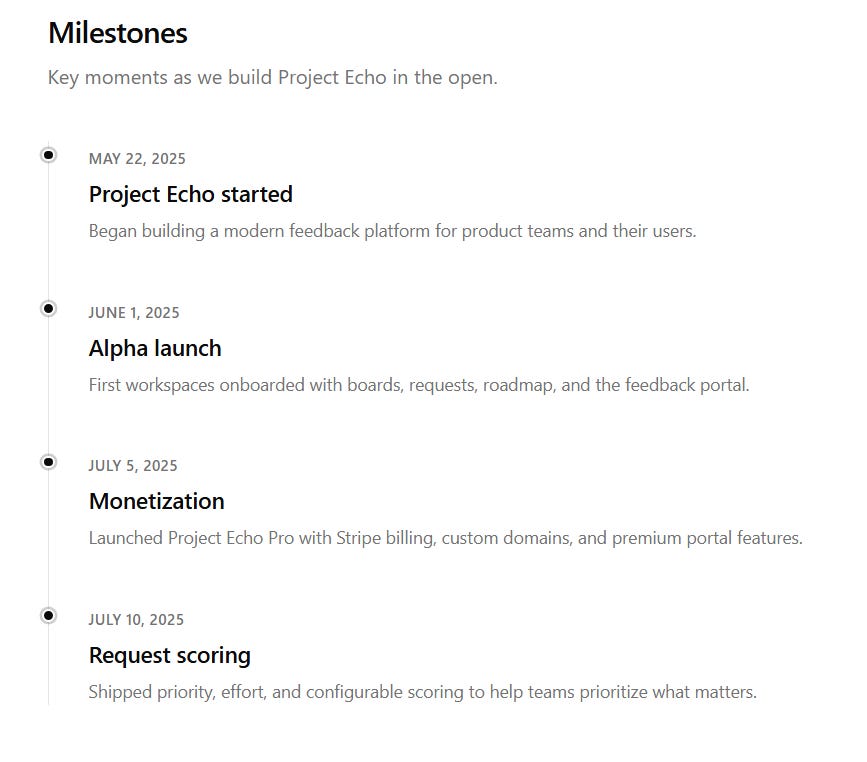
I’m sure I’ll add some other information to the page as time goes on.
I think showing the actual P&L (profit and loss) statement for the SaaS would be a nice addition. A breakdown of the tech stack and supporting tools will also be published sometime in the future.
What else would you like to see on the page? Let me know in a comment below.
A product demo of Project Echo
Last night I decided to record a product demo of Project Echo.
I wanted a video that shows off the product that I could embed on the homepage (it’s almost always better to show than tell), and also use to market it on social media.
I recorded the video using Loom and edited it (I needed to add some blur effects to hide sensitive user info) using Filmora.
You can find the video below.
The video is shown above the fold on the homepage so visitors can get a sense of what Project Echo does before they sign up. I’m confident the video will help with conversion.
The only issue is the video is too long. At almost 16 minutes, that’s a long product demo. For now I’m using it since having one is better than not but I might record a new one in the future which is shorter.
I think SaaS founders are more likely to sit through a 15 min product demo than the average person, especially if they are researching their options, so I don’t think it’s a huge deal. I also purposefully went with YouTube as the video host to a) save money, and b) to allow people to fast forward easily. It’s also easy to share a YouTube video.
I’m also pushing the video in the welcome email I’ve set up for new users in Intercom.
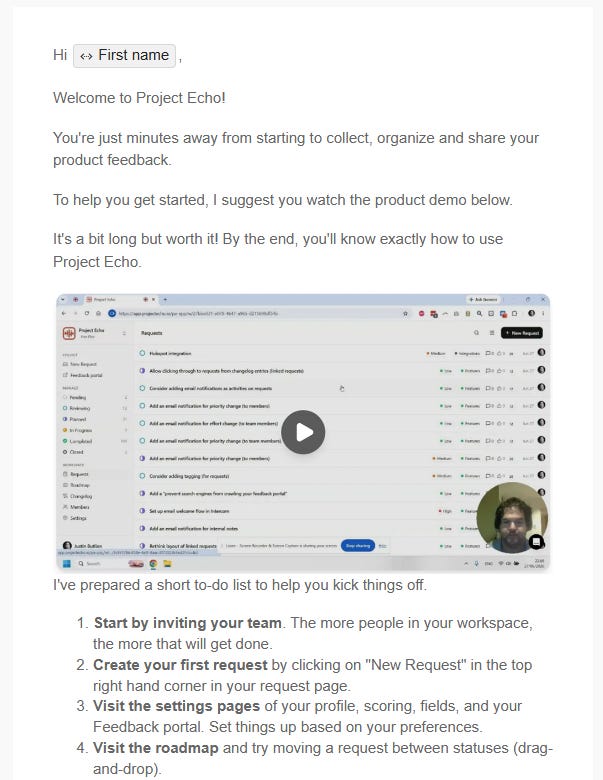
Since the demo video covers the majority of the platform, I want to encourage new users to watch it since that will help with activation and feature adoption.
The switch to marketing
Now that the Project Echo product is in a decent place, it’s time for me to switch gears to marketing.
As of now less than 10 people have signed up to Project Echo which isn’t enough to help me understand how the onboarding flow performs, or why users aren’t sticking around.
I need to significantly improve this number which means spending time driving relevant traffic to the website.
I need hundreds of signups to create enough data for me to model out the activation rate, conversion to paid, retention and expected usage.
Up until now my marketing efforts have been sporadic and unstructured, that needs to change. I need to build a clear plan and execute on it.
One major change I made this past week was replacing the “join waitlist” button on the homepage with a “sign up” button. I essentially ungated public access to the app and now anyone with an email address, or Google account, can sign up to Project Echo.
I didn’t think there was much of a point in preventing visitors that land on the website from signing up to the service. I need data and adding friction didn’t make sense.
There is a bit of work I can do on improving the onboarding flow but overall it’s not a blocker.
If I had a far larger audience and was confident I could get dozens of SaaS founders to join the waitlist (and then sign up to the closed alpha launch), then it could make sense to close off public access, at least for a few weeks.
Over the next week or two I will be building a marketing plan for Project Echo that I’ll share with you once it’s ready.
The goal now is to move towards clear product-market fit and to understand what’s working, what’s not, and how to turn signups into sticky users.
The immediate milestone is 100 signups.
Wish me luck.
That’s it for this week. Thanks for reading and I’ll see you in the next one.
Justin